London-based agricultural robotics company Muddy Machines secured £7.8 million in Series A funding during October 2024, positioning the startup to scale commercial deployment of its artificial intelligence-powered crop harvesting robots across United Kingdom farms. The investment round attracted participation from venture capital firms specialising in agricultural technology alongside strategic investors with operational expertise in fresh produce supply chains.
The funding represents one of the largest Series A rounds for a UK agricultural robotics company in 2024, reflecting growing investor confidence in automation solutions addressing persistent labour shortages affecting British horticulture. Muddy Machines targets labour-intensive vegetable crops where manual harvesting costs account for 40-60% of total production expenses and seasonal worker availability continues declining.
Technology Innovation and Platform Capabilities
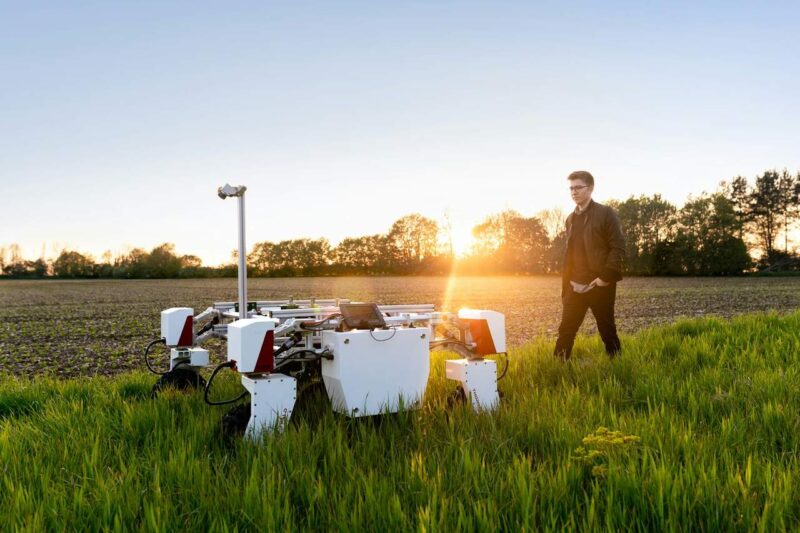
Muddy Machines develops modular robotic systems combining autonomous navigation, computer vision, and crop-specific end effectors designed for delicate harvesting operations that historically resisted mechanical automation. The platform employs machine learning algorithms trained on thousands of crop images, enabling real-time assessment of ripeness, quality, and optimal harvest timing for individual plants.
The robots operate on battery power exclusively, eliminating diesel consumption and reducing operational carbon emissions to near zero. Battery capacity supports 8-12 hours of continuous operation depending on field conditions and harvesting intensity, with swap-out battery packs enabling 24-hour operation during peak harvest periods without equipment downtime for charging.
Computer vision systems identify individual crops within dense foliage, distinguishing between ready-to-harvest produce and immature plants requiring additional growing time. This selective harvesting capability matches human picker discernment whilst maintaining consistent quality standards that automated systems executing simple cutting patterns cannot achieve.
Custom harvesting tools represent core intellectual property differentiating Muddy Machines from competitors pursuing generalised robotic platforms. The company designs crop-specific end effectors for vegetables including asparagus, broccoli, and cauliflower, acknowledging that universal harvesting mechanisms compromise efficiency and crop quality compared to purpose-built tools.
Autonomous navigation employs GPS guidance combined with vision-based row following, enabling operation without physical infrastructure modifications to existing fields. The system adapts to varied row spacing, plant density, and field conditions without requiring standardised growing systems that constrain farmer agronomic decisions.
Target Crops and Market Focus
Initial commercial deployment concentrates on asparagus, where manual harvesting requires skilled workers executing precise cuts at optimal stem heights. Asparagus presents particularly acute labour challenges given the crop’s concentrated harvest window and need for daily picking during peak production periods.
The startup estimates UK asparagus growers spend approximately £18-24 per hour for skilled harvest labour when accounting for wages, national insurance contributions, accommodation provision, and transport costs. Robotic harvesting reduces these costs to an estimated £8-12 per hour equivalent when capital costs are amortised across expected equipment lifespans and operational expenses are included.
Broccoli represents the second target crop, with pilot systems currently undergoing field trials at commercial production sites. Broccoli harvesting demands identification of properly sized heads and precise cutting to maintain stem length specifications, requirements that challenge simpler mechanical harvesters but suit AI-guided robotic systems making individualised harvest decisions.
Cauliflower deployment is planned for 2026, following completion of development work adapting vision systems and cutting mechanisms to the crop’s distinct morphology and harvest requirements. The company pursues sequential crop introduction rather than simultaneous multi-crop launches, focusing engineering resources on achieving commercial reliability in each application before expanding to additional vegetables.
Market selection emphasises crops where labour costs represent the largest production expense component and seasonal worker availability creates operational bottlenecks constraining production volumes. Muddy Machines avoids grain crops and other commodity categories where large-scale mechanical harvesters already provide adequate automation solutions.
Pilot Deployments and Commercial Trials
Field trials commenced during spring 2024 across three UK asparagus operations in Worcestershire, Norfolk, and Scotland. The pilot programme deployed pre-production robots operating alongside human pickers, enabling direct performance comparisons and identification of technical refinements required before full commercial release.
Trial results from the 2024 asparagus season showed robotic systems achieved harvest rates of 85-92% compared to experienced human pickers, with quality rejection rates running 3-6 percentage points higher than manual harvesting. These performance metrics exceeded internal targets for initial commercial deployment, though the company acknowledges continued improvement is necessary to match top-tier human picker output fully.
Operational reliability data gathered during trials indicated mechanical availability of 91% across the harvest season, with most downtime attributable to minor component failures resolved through field repairs. This reliability level meets commercial deployment thresholds, though Muddy Machines continues design refinements aimed at achieving 95%+ availability matching farmer expectations for critical harvest equipment.
Weather adaptability testing revealed limitations in heavy rain conditions where moisture interfered with vision system performance and increased risk of crop damage from wet handling. The robots currently require operational suspension during persistent rain, a constraint the company is addressing through improved waterproofing and alternative sensor technologies less susceptible to water interference.
Grower feedback from pilot participants emphasised the importance of simple operation and minimal technical expertise requirements. Muddy Machines responded by developing tablet-based interfaces enabling farmers to programme daily harvest instructions without specialised training, whilst remote monitoring capabilities allow company technical staff to provide troubleshooting support without farm visits.
Founding Team Background
Florian Richter and Christopher Chavasse established Muddy Machines in 2021, bringing complementary skills in artificial intelligence and agricultural engineering. Richter holds a doctorate in machine learning from Imperial College London, where his research focused on computer vision applications in unstructured outdoor environments, whilst Chavasse brings experience from agricultural machinery design and field robotics development.
The founding team identified crop harvesting as an application where AI capabilities could deliver transformative value rather than incremental improvements over existing automation. Initial technology development occurred through accelerator programmes including Entrepreneurs First and the Royal Agricultural University’s agritech incubator, providing early-stage funding and mentorship as prototypes evolved from concept to field-ready systems.
The London location proved advantageous for recruiting software engineers and AI specialists, despite the company’s operational focus on rural agricultural applications. Richter noted in media interviews that accessing top-tier technical talent justified the London base even as product development and testing necessitated frequent travel to farming regions.
Team expansion following Series A funding prioritises field application engineers and agronomists who understand practical farming constraints and can translate grower needs into product requirements. The company reached 28 employees by late 2024, with planned growth to approximately 45 staff by end of 2025 as commercial deployment accelerates.
Investor Backing and Capital Strategy
The £7.8 million Series A round drew lead investment from Octopus Ventures, a London-based venture capital firm with existing agricultural technology portfolio companies. Octopus partner Hannah Seal joined Muddy Machines’ board as part of the investment, bringing experience from previous agtech investments and connections across UK farming networks.
Additional participation came from Muddy Machines’ existing seed investors, including Entrepreneurs First and several angel investors with agricultural industry backgrounds. Strategic investors included a major UK vegetable producer operating substantial asparagus acreage, though the company declined to identify this investor publicly due to confidentiality requirements.
The funding will support manufacturing capacity expansion, with Muddy Machines establishing assembly operations capable of producing 50-75 units annually by mid-2025. Current production occurs through third-party engineering firms assembling small batches, but scaled deployment requires dedicated manufacturing capabilities and supply chain development for custom components.
Commercial team growth represents a second capital allocation priority, as the company transitions from pilot programmes with early adopter farms to broader market sales requiring field sales representatives, demonstration events, and dealer relationship development. Muddy Machines plans to employ six to eight commercial staff by harvest season 2025, covering key vegetable production regions.
Continued research and development consumes approximately 40% of Series A proceeds, funding work on new crop applications, performance improvements for existing systems, and long-term technology development including enhanced autonomy and multi-robot coordination enabling fleet operations across large production sites.
Market Opportunity Assessment
The addressable market for robotic vegetable harvesters in the United Kingdom encompasses approximately 140,000 hectares of high-value horticultural crops where manual harvesting predominates. Market research commissioned by Muddy Machines suggests mechanisation rates below 15% across target crops, compared to 95%+ mechanisation in grain production.
Labour availability trends support accelerating automation adoption, as seasonal agricultural worker numbers fell 31% between 2019 and 2024 according to Home Office visa issuance data. This workforce decline shows no indication of reversal, creating sustained pressure on growers to identify alternative production methods maintaining output without proportional labour increases.
Equipment pricing strategy targets deployment economics that deliver investment returns within four to five years based on labour cost savings alone, without valuing additional benefits including extended harvest windows, reduced crop losses from labour shortages, and harvest timing optimisation improving crop quality. Current pricing for complete systems runs approximately £185,000-240,000 depending on configuration and included features.
Financing arrangements will prove critical to market penetration, as upfront capital costs exceed typical annual machinery investment budgets for many vegetable growers. Muddy Machines is developing operational lease structures allowing farmers to deploy robots through monthly payments rather than capital purchases, shifting financial models from equipment ownership to robotics-as-a-service subscriptions.
Market expansion beyond the UK forms part of the long-term strategy, with European markets including France, Spain, and the Netherlands representing substantial opportunities once domestic deployment establishes operational track records. However, the company emphasises UK market development through 2026 before pursuing international expansion requiring additional capital and organisational capabilities.
Competitive Landscape Analysis
Muddy Machines competes in an increasingly active agricultural robotics sector, though direct competition remains limited for vegetable harvesting applications specifically. French company Naio Technologies offers weeding robots targeting vegetable production but has not deployed harvesting systems commercially, instead focusing on mechanical weed control during crop establishment phases.
Small Robot Company, a fellow UK agricultural robotics startup, pursues cereal crop applications including precision drilling and weed elimination in grain production systems. The company’s technology and target markets differ substantially from Muddy Machines’ horticultural focus, positioning the companies as complementary rather than directly competitive despite both operating in agricultural robotics.
Established agricultural machinery manufacturers including John Deere, AGCO, and CNH Industrial have announced research programmes investigating robotic harvesting but have not released commercial systems for labour-intensive vegetable crops. These companies face organisational challenges adapting business models built around large capital equipment sales to smaller-scale robotic systems requiring different service models and go-to-market approaches.
University research programmes at institutions including the University of Lincoln, Harper Adams University, and the University of Plymouth actively develop agricultural robotics prototypes. These academic initiatives contribute intellectual property and technical talent to the sector but generally lack commercialisation capabilities and capital access enabling market deployment at scale.
International competitors including Harvest CROO Robotics in the United States focus on strawberry harvesting, representing adjacent rather than overlapping market segments to Muddy Machines. The different crop characteristics and production systems between soft fruit and vegetables create distinct technical requirements limiting direct competition despite both addressing manual harvest labour challenges.
Technical Challenges and Development Priorities
Vision system performance under variable lighting conditions remains an active development focus, as cloud cover transitions, dawn and dusk operation, and shadows cast by crops themselves create detection challenges that laboratory testing cannot fully replicate. Machine learning model training requires extensive field image libraries capturing the full range of real-world conditions robots encounter during commercial deployment.
End effector reliability presents ongoing engineering challenges, as cutting mechanisms face contamination from crop residue, soil particles, and plant sap that compromise performance over extended operation periods. Muddy Machines tests multiple cutting technologies and cleaning systems identifying solutions that maintain performance across full harvest days without manual intervention.
The robots must navigate uneven terrain, wet soil conditions, and unexpected obstacles including irrigation equipment, fallen crop supports, and wildlife without becoming immobilised or causing crop damage. Mobility system design balances the conflicting requirements of minimal ground pressure reducing soil compaction and adequate traction maintaining forward progress in challenging field conditions.
Battery technology selection involves trade-offs between energy density, recharge rates, operational temperature ranges, and cost. The company currently employs lithium-ion battery packs but monitors solid-state battery development and other emerging technologies potentially offering performance advantages as they reach commercial availability.
Cybersecurity receives increasing attention as connected agricultural equipment faces potential vulnerabilities to unauthorised access or malicious interference. Muddy Machines implements encrypted communications, secure software update mechanisms, and intrusion detection capabilities protecting against cyber threats that could compromise operations or expose farmer data.
Business Model and Revenue Strategy
Muddy Machines pursues a hybrid revenue model combining equipment sales with ongoing service subscriptions and software licensing fees. This approach generates immediate revenue from hardware sales whilst building recurring income streams supporting long-term business sustainability and providing capital for continued research and development.
Service agreements include remote monitoring, technical support, software updates, and annual maintenance performed by company technicians or authorised service partners. These subscriptions are priced at approximately 8-12% of equipment purchase cost annually, providing farmers with operational support and ensuring Muddy Machines maintains engagement with deployed systems.
Software licensing fees apply to advanced features including fleet coordination, harvest planning optimisation, and integration with farm management information systems. The company positions these capabilities as premium offerings delivering additional value beyond basic robotic harvesting functionality, enabling tiered pricing that serves diverse customer segments from cost-focused operations to technology-leading growers.
Data services represent a potential future revenue stream, as robots generate detailed information about crop performance, field conditions, and harvest outcomes valuable for agronomic decision-making. However, Muddy Machines emphasises that farmer data remains farmer-owned, with any commercial data utilisation requiring explicit consent and offering value-sharing arrangements.
The company anticipates equipment sales will dominate revenue through 2027 as initial market penetration occurs, with service subscriptions and software licensing growing to represent 30-40% of total revenue by 2028-2029 as the installed base expands and customers adopt advanced capabilities.
Growth Trajectory and Future Plans
Commercial deployment targets call for 40-60 robot units operating across UK farms by the end of 2025 harvest season, ramping to 150-200 units by end of 2026. These volumes enable transition from startup to established equipment provider whilst remaining manageable given current organisational capabilities and service infrastructure.
Manufacturing partnerships are under negotiation with UK-based engineering firms possessing agricultural equipment production experience and quality systems meeting commercial deployment requirements. Domestic manufacturing supports local economic development objectives and simplifies logistics compared to offshore production, though component sourcing remains global given specialised sensor and computing hardware requirements.
Dealer network development will commence during 2025, with Muddy Machines seeking agricultural machinery dealers in key vegetable production regions willing to invest in demonstration equipment and technical training. The dealer model enables geographic coverage and local customer relationships that a direct sales force could not achieve economically at the company’s current scale.
Research collaboration with UK universities continues expanding, with joint projects investigating next-generation capabilities including multi-crop harvesting systems, advanced crop quality assessment, and integration between robotic harvesters and automated logistics equipment moving produce from field to packhouse.
Series B fundraising is anticipated for late 2025 or early 2026, targeting £15-20 million to fund manufacturing scale-up, international market entry preparation, and development of additional crop-specific harvesting systems. The timing depends substantially on commercial deployment success during the 2025 growing season demonstrating market demand and validating technical performance claims.
Muddy Machines exemplifies the emerging generation of UK agricultural technology companies applying artificial intelligence and robotics to persistent farming challenges. The company’s trajectory from university research to commercial deployment illustrates both the opportunities and obstacles facing agtech startups pursuing hardware-intensive innovation in traditionally conservative agricultural markets. Success depends on maintaining technical performance gains whilst navigating the complex realities of farming economics, seasonal operations, and risk-averse customer decision-making that characterise agricultural equipment markets.