
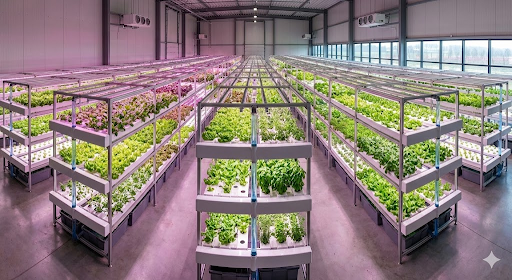
Hydroponic cultivation enables UK growers to produce high-quality crops year-round without traditional soil-based methods. Whether considering hydroponics as a business venture, exploring urban farming opportunities, or seeking to understand soil-free growing systems, successful production requires careful planning and informed decision-making rather than simply purchasing equipment and hoping for results.
The fundamental advantage of hydroponics lies in delivering water and nutrients directly to plant roots in precisely controlled quantities. This eliminates the variability inherent in soil growing, potentially increasing yields whilst substantially reducing water consumption compared to conventional methods. However, these benefits come with trade-offs including capital requirements, technical knowledge demands, and the need for consistent monitoring and management.
Understanding Hydroponic System Types
Nutrient Film Technique (NFT)
NFT systems circulate a thin film of nutrient solution through gently sloped channels, with plant roots suspended in the flowing liquid. This method suits fast-growing leafy crops like lettuce, rocket, and herbs particularly well. The continuous flow provides excellent oxygenation whilst preventing waterlogging, though system failures from pump breakdowns can damage crops within hours if not addressed quickly.
A basic NFT setup requires growing channels (typically PVC guttering or purpose-made profiles), a reservoir tank, circulation pump, and return plumbing. Channel length typically ranges from 8-12 metres with 1:100 slope gradient recommended. Plant spacing depends on crop type, with lettuce commonly positioned at 200mm centres and herbs at 150mm intervals. Flow rates should maintain a thin film keeping roots moist without creating standing water.
NFT systems prove economical for scaled production once established, making them popular choices for commercial lettuce and herb operations. The simplicity of design enables troubleshooting and maintenance without extensive technical knowledge, though pump reliability becomes critical given the system’s dependence on continuous circulation.
Deep Water Culture (DWC)
DWC systems suspend plant roots directly in oxygenated nutrient solution contained in reservoirs or tanks. Air pumps drive oxygen through diffusers positioned at tank bottoms, creating the bubble action essential for root health. This method works exceptionally well for fruiting crops like tomatoes, cucumbers, and peppers, which develop extensive root systems that thrive in the oxygen-rich environment.
Individual DWC units typically employ containers for single plants, whilst raft systems float plants on polystyrene sheets above larger shared reservoirs. The raft approach suits commercial lettuce production particularly well, with some UK growers operating substantial systems where plants float from seedling size through harvest.
DWC running costs remain relatively moderate, with air pumps consuming modest electricity continuously and requiring replacement approximately every 18-24 months. The simplicity of design makes DWC attractive for beginners, though managing solution temperature becomes more critical in warmer months to prevent root disease problems.
Ebb and Flow (Flood and Drain)
Ebb and flow systems periodically flood growing trays with nutrient solution before draining back to a reservoir, repeating the cycle multiple times daily. Plants grow in individual pots filled with inert media like clay pebbles or perlite. This method provides excellent flexibility for growing diverse crops simultaneously and suits growers who prefer substrate-based cultivation.
Flood frequency depends on media type, plant size, and environmental conditions. Clay pebble systems typically flood every 2-4 hours during daylight, whilst coconut coir substrates might require only 2-3 floods daily. Timer controllers automate the process, though monitoring ensures pumps function correctly and overflow drains remain clear.
Media represents an ongoing consideration for ebb and flow systems, though quality clay pebbles can be cleaned and reused for multiple crops, reducing long-term operating costs. The versatility of substrate-based growing appeals to growers transitioning from soil cultivation who appreciate the familiar growing medium whilst benefiting from hydroponic nutrient control.
Drip Irrigation Systems
Drip systems deliver nutrient solution directly to individual plants through small emitters, with excess draining to waste or returning to the reservoir for recirculation. This approach provides exceptional control over individual plant nutrition and suits operations growing multiple crop types simultaneously. Commercial tomato and pepper production frequently employs drip systems using coconut coir or rockwool slabs as growing substrate.
Drip emitter selection affects irrigation uniformity and maintenance requirements. Pressure-compensating emitters maintain consistent output across long runs and elevation changes, whilst non-compensating units prove adequate for smaller installations with minimal height variation. Flow rates typically range from 2-4 litres per hour per emitter, with irrigation frequency and duration adjusted based on crop demands and substrate characteristics.
Professional installations in commercial greenhouses often incorporate fertigation controllers providing automated nutrient and pH management, though smaller operations successfully manage drip systems with manual monitoring and adjustment.
Scale Considerations for First-Time Growers
Hobby Scale Operations
Hobby growers can establish productive systems occupying modest spaces. A small NFT or DWC setup will produce regular harvests of lettuce or supply fresh herbs for personal use with surplus for friends and local sales. These systems typically fit in spare rooms, garages, or small greenhouses, requiring LED growing lights and basic monitoring equipment including pH and EC meters.
Environmental control at hobby scale often relies on manual adjustments rather than automated systems. Growers monitor temperatures and adjust heating or ventilation manually, check pH and nutrient levels daily, and maintain solution temperatures through reservoir placement rather than chillers. This approach demands more personal attention but avoids equipment costs associated with automation whilst providing valuable learning experiences.
Small Commercial Scale
Aspiring commercial growers targeting local markets, restaurants, or farmers’ markets typically require 20-50 square metres of production space. At this scale, operations support substantial weekly production once established, generating revenue potential that can reach profitability within 12-18 months assuming consistent production quality and reliable market outlets.
Investment requirements extend beyond growing systems to include adequate lighting for indoor operations, environmental control managing temperature and humidity, monitoring equipment automating or simplifying pH and nutrient management, and contingency funds for unexpected repairs or crop losses during the learning period.
Medium Commercial Scale
Professional operations targeting wholesale markets, multiple retail accounts, or packhouse supply typically operate 100-250 square metres of growing space. These facilities require proper environmental control, backup power systems protecting against crop loss from electrical failures, water treatment equipment ensuring consistent input quality, and professional-grade monitoring alerting growers to developing problems before they damage crops.
At this scale, automation becomes economically justified and practically necessary. Climate control systems maintain temperature and humidity within narrow ranges, automatic dosing systems manage pH and nutrient strength, and monitoring platforms provide remote access and alerts. Labour requirements increase substantially, with operations typically employing 2-3 staff for daily operations, harvesting, and packaging.
Selecting Beginner-Appropriate Crops
Lettuce Varieties
Lettuce represents the ideal starting crop for new hydroponic growers. Plants mature in 35-45 days from transplant, tolerate modest environmental variations, and demonstrate clear responses to nutrient and management changes. Butterhead varieties suit beginners particularly well, proving forgiving of minor pH fluctuations and nutrient imbalances that might damage more sensitive crops.
Leaf lettuces provide continuous harvest options where outer leaves can be picked whilst plants continue growing. This extends production from individual plants and helps smooth cash flow for new operations. Expected yields vary substantially based on growing conditions, variety selection, and management quality, though well-managed systems consistently produce marketable heads.
Market prices vary substantially by season, outlet, and quality, with wholesale rates differing significantly from direct sales through farmers’ markets or veg box schemes. Growing specific varieties requested by restaurant customers often commands premium pricing, though consistent supply becomes critical for maintaining these relationships.
Culinary Herbs
Basil, coriander, mint, and parsley thrive in hydroponic systems and command strong prices relative to production space requirements. Basil proves especially suitable for beginners, growing rapidly in NFT systems with harvests possible 4-6 weeks after transplant. Genovese basil remains the commercial standard, though speciality varieties like Thai, lemon, or purple basil can differentiate offerings.
Herb production differs fundamentally from lettuce in harvest approach. Rather than single-harvest crops, herbs undergo multiple cuttings over 8-16 week production cycles. This generates more consistent income but requires more sophisticated crop planning to ensure continuous supply as plants at various growth stages cycle through the system.
Wholesale herb pricing varies by variety and market, with premium varieties or organic certification commanding higher returns. Established herb systems can produce substantial weekly harvests, though expect 4-6 weeks of minimal harvest whilst initial plantings mature sufficiently for first cuttings.
Tomatoes and Cucumbers
Fruiting crops like tomatoes and cucumbers demand more environmental control, technical knowledge, and patience than leafy crops, but offer substantially higher revenue potential per square metre. These crops suit growers who have mastered lettuces and herbs and are ready to progress toward more challenging production.
Tomato varieties divide between determinate types that fruit over concentrated periods and indeterminate types that produce continuously over extended seasons. Beginners should start with determinate cherry or cocktail varieties, which prove more forgiving than large beefsteak types whilst still commanding good prices. Production cycles extend considerably longer than leafy crops, requiring sustained environmental management and attention to plant health.
Cucumbers grow well in DWC or drip systems, with European greenhouse varieties suited to protected cultivation. These crops require trained support, regular pruning, and sometimes hand pollination in protected environments without insect activity. Initial learning curves can be steep, but experienced growers achieve considerably higher returns per square metre than leafy crop production provides.
Nutrient Management Fundamentals
Understanding NPK and Micronutrients
Hydroponic nutrients supply all essential elements that soil would normally provide. The three primary macronutrients include nitrogen for leafy growth, phosphorus for root development and flowering, and potassium for overall plant health and disease resistance. Secondary nutrients comprise calcium, magnesium, and sulphur, whilst micronutrients include iron, manganese, zinc, copper, boron, and molybdenum.
Commercial hydroponic nutrients come premixed in concentrated liquid or powder forms, typically as two-part formulations that prevent precipitation when stored. Part A usually contains calcium, whilst Part B provides other nutrients that would react with calcium in concentrated form. Mixing both parts in the reservoir at specified ratios creates complete nutrient solutions.
Different crops require different nutrient formulations. Leafy crops generally need higher nitrogen ratios, whilst fruiting crops require more balanced or potassium-heavy formulations during fruit development Hydro How-ToOklahoma State University. Most nutrient manufacturers provide crop-specific products, simplifying selection for beginners.
pH Control Requirements
Solution pH dramatically affects nutrient availability, with most hydroponic crops performing best between pH 5.5-6.5 Hydro How-ToHydroponics Europe. Below this range, certain micronutrients can reach toxic levels whilst calcium and magnesium become less available. Above this range, iron and other micronutrients precipitate and become unavailable to plants, causing deficiency symptoms despite adequate supply.
Nutrient solutions naturally drift toward higher pH as plants uptake nutrients. Commercial pH adjusters (typically phosphoric acid for pH down and potassium hydroxide for pH up) correct this drift. Add adjusters gradually in small doses, mixing thoroughly and rechecking before adding more. Dramatic pH swings stress plants, so aim for gradual adjustments over hours rather than minutes.
Check pH daily during initial operation until you understand how quickly your specific system drifts. Some growers find their systems stable for 3-4 days, whilst others require daily adjustments. Water quality affects pH stability substantially, with high carbonate content causing faster upward drift requiring more frequent intervention.
Electrical Conductivity Monitoring
Electrical conductivity (EC) measures dissolved salt concentration in nutrient solutions, providing an indirect assessment of nutrient strength. Typical EC targets range from 1.2-2.2 mS/cm for lettuce and herbs, rising to 2.0-3.5 mS/cm for tomatoes and cucumbers Hydro How-ToVertefarm. Young seedlings require lower EC, whilst mature plants tolerate higher concentrations.
EC rises as plants remove water faster than nutrients, concentrating remaining salts in the solution. Conversely, EC can fall if plants consume nutrients faster than water, though this occurs less commonly. When EC drifts outside target ranges, either dilute with fresh water or dump the solution and mix fresh nutrients. Attempting to adjust high-EC solutions by adding only water eventually creates imbalanced nutrient profiles as individual elements become depleted at different rates.
Most growers completely replace nutrient solutions every 2-3 weeks for leafy crops and weekly for heavy-feeding fruiting crops. This prevents accumulation of unused nutrients and salts whilst ensuring balanced nutrition. The replaced solution can often irrigate outdoor gardens, preventing waste whilst providing value from the nutrient content remaining in the discarded solution.
Water Quality Considerations
Source Water Assessment
UK mains water quality varies substantially by region, affecting hydroponic suitability. Soft water areas (Scotland, Wales, northern England) typically provide excellent starting water requiring minimal treatment. Hard water regions (southern and eastern England) may contain substantial dissolved carbonates and minerals, significantly affecting pH stability and nutrient balance.
Before establishing a hydroponic operation, obtain a water analysis from your supplier or conduct testing yourself. Key parameters include pH, total dissolved solids, carbonate hardness, calcium, magnesium, sodium, and chlorine content. This information guides decisions about filtration needs and nutrient formulation adjustments required for your specific water supply.
Chlorine in municipal water rarely poses problems at typical UK levels, dissipating naturally within 24 hours if solutions are aerated. However, some water authorities occasionally use chloramine, which persists longer and may require activated carbon filtration or specific neutralising products before use in hydroponic systems.
Filtration and Treatment Options
Most small-scale operations can use mains water directly, especially in soft water areas. Hard water regions may benefit from reverse osmosis (RO) filtration, which removes most dissolved minerals and provides consistent starting water regardless of seasonal supply variations. RO systems suitable for hydroponic operations produce substantial daily volumes whilst rejecting a portion of input water as waste, requiring consideration of water consumption and disposal.
Some growers collect rainwater as an alternative to mains supply, particularly attractive given zero water costs and naturally soft composition. However, rainwater collection requires proper filtration, UV sterilisation to prevent pathogen introduction, and adequate storage capacity. Complete rainwater systems with appropriate storage suit operations with consistent weekly water demands.
UK Regulatory Requirements and Permissions
Planning Considerations
Hydroponic operations established within existing buildings (garages, industrial units, barns) rarely require planning permission if no external changes occur and use remains within the building’s planning class. Converting agricultural buildings to hydroponic production normally falls within permitted development rights for agricultural operations.
Constructing new buildings or polytunnels for hydroponic production requires planning permission in most circumstances, with requirements varying by local authority. Applications typically take 8-12 weeks for processing. Consult your local planning authority early in project development to understand specific requirements and avoid delays.
Operations in urban areas may face additional considerations regarding noise from ventilation equipment, light pollution from growing lights, and traffic from deliveries or customer visits. Addressing these factors in planning applications or through considerate system design prevents neighbour disputes and potential enforcement actions that could disrupt operations.
Water Discharge Regulations
Nutrient solution disposal requires careful attention to environmental regulations. Small hobby operations typically dispose of spent solutions onto gardens or non-food crops without issues. However, commercial operations discharging substantial volumes daily to sewers require trade effluent consent from water companies GOV.UK.
Discharging nutrient solutions to surface water (streams, rivers, drainage ditches) requires environmental permits from the Environment Agency (England), Natural Resources Wales, or Scottish Environment Protection Agency depending on location. These permits assess environmental impact and may impose treatment requirements or discharge limits GOV.UK.
Most commercial growers either dispose of solutions to sewers under trade effluent consent or use them for irrigating outdoor crops, avoiding the complexity and expense of environmental permitting for direct water body discharge. The nutrient content remaining in spent solutions provides value for conventional growing whilst resolving disposal challenges.
Common Mistakes to Avoid
Overcomplicating Initial Systems
New growers frequently purchase unnecessarily complex equipment with automation and monitoring features they lack experience to utilise effectively. A simple manual system allows learning fundamental crop responses and developing management skills before progressing to automation. Master pH adjustment, nutrient mixing, and recognising plant stress signals before investing in automated dosing and control systems.
Start with one crop type and simple systems like NFT or DWC rather than attempting multiple crops in complex recirculating systems. Success with modest numbers of healthy plants teaches more than struggling with larger volumes across multiple crop types simultaneously. Expand crop diversity and system complexity gradually as experience and confidence develop through successful production cycles.
Neglecting Environmental Control
Hydroponics provides perfect root zone conditions, but plants still require appropriate temperature, humidity, and air circulation in the growing environment. Many beginners focus entirely on nutrient management whilst overlooking poor ventilation, excessive heat, or inadequate light. Lettuce performs best at moderate temperatures, whilst tomatoes prefer warmer conditions. Operating outside optimal ranges limits yields regardless of perfect nutrition.
Invest in proper environmental monitoring from the beginning. Basic temperature and humidity meters provide essential information for diagnosing problems and optimising conditions. Record environmental data alongside crop observations to identify patterns and improve management over time, building knowledge that informs future production decisions.
Insufficient Working Capital
Hydroponic businesses require several months of operation before reaching profitability. Budget for multiple months of operating expenses including utilities, nutrients, seeds, packaging, and living costs if pursuing hydroponics as primary income. Many promising operations fail not from production problems but from insufficient capital to sustain operations whilst building markets and refining production systems.
Expect to waste some crops whilst learning. Every grower experiences nutrient mistakes, pH crashes, pest outbreaks, or equipment failures that damage or destroy production. Build these learning experiences into financial planning rather than assuming everything will work perfectly from the beginning. The knowledge gained from mistakes proves invaluable for long-term success.
First-Year Realistic Expectations
Production Learning Curve
Most growers achieve a substantial portion of potential yields during their first season, improving steadily by the end of year two as experience accumulates. First crops often experience problems including uneven growth, nutrient deficiencies, premature bolting, or lower quality than anticipated. These experiences teach valuable lessons, though they impact initial revenue expectations.
Plan for 3-4 complete crop cycles before expecting consistent results. The first crop teaches basic system operation and reveals initial mistakes. The second crop allows applying those lessons, though new problems typically emerge. By the third and fourth crops, most growers develop reliable production routines and consistent quality meeting market expectations.
Market Development Timeline
Developing reliable sales channels takes time regardless of production quality. Restaurants often require samples, multiple visits, and demonstrations of consistent supply before committing to regular purchases. Farmers’ markets require advance planning and stall fees with no guarantee of sales. Wholesale relationships demand demonstrated reliability over months before buyers depend on you for significant volumes.
Start building market relationships several weeks before first harvest. Provide samples to potential customers, discuss their needs and preferences, and set realistic expectations for when regular supply begins. Some growers successfully presell their first crops to supportive local customers, generating cash flow whilst building a customer base for future production.
Scaling Pathway
Successful first-year operations often consider expansion. However, resist aggressive scaling until production systems run smoothly, markets can absorb additional volume, and capital exists for investment without overleveraging the business. Many promising hydroponic businesses failed by expanding too rapidly before establishing operational proficiency and market stability.
A practical scaling pathway involves measured capacity increases after 12-18 months of successful operation, allowing consolidation of systems, markets, and skills before each expansion phase. This measured approach builds sustainable businesses rather than spectacular collapses from overextension beyond management capacity or market demand.
Hydroponic growing offers genuine opportunities for producing high-quality crops in controlled environments throughout the year. Success demands careful planning, realistic expectations, continuous learning, and persistent attention to both crop needs and market development. The growers who approach hydroponics systematically, learn from inevitable mistakes, and build skills progressively will find satisfying and potentially profitable production systems emerge from their initial efforts.