AI in agriculture covers software that answers farmers’ questions, spots pests in photographs, estimates yields for insurers, reads satellite images and steers machines and greenhouses. In India, the government’s Kisan e-Mitra chatbot had answered more than 93 lakh queries by December 2025, and in the United Kingdom a £40 million network of robotics adoption hubs began rolling out on 9 October 2026.
In our assessment, the money and the claims around AI in agriculture are growing faster than the evidence. This guide sets out where artificial intelligence is used on farms and in farm services, the public programmes in India and the UK, what published results show, the data questions, and what it all means for agritech, input and machinery companies.
What AI in agriculture covers
A PIB explainer published on 14 February 2026 groups farm uses of artificial intelligence into four areas: soil health diagnostics from satellite, drone and farm images; climate-responsive crop monitoring and advisory; more efficient farm machinery, including precision weeding, automated harvesting and produce grading; and better price realisation through demand forecasting and market intelligence.
In practice, the artificial intelligence products described in official and company releases fall into five groups. They are conversational advisers and chatbots, image-based pest and disease detection, yield estimation for crop insurance, satellite and weather-based crop monitoring, and robotics and autonomous control of machines and greenhouses. Breeding is a sixth, newer use, where machine learning is applied to genetic data.
The common input is data: farmer records, plot boundaries, crop images, weather, soil and market prices. That is why digital public infrastructure such as India’s AgriStack, explained in our AgriStack guide, sits underneath much of the public AI in agriculture effort in India.
AI in agriculture in India: advisory chatbots and weather forecasts
Kisan e-Mitra, launched in 2023, is a voice-enabled artificial intelligence chatbot that answers questions on schemes such as PM-KISAN, the Kisan Credit Card and the Pradhan Mantri Fasal Bima Yojana. It works in 11 regional languages and handles over 8,000 queries a day, according to the February 2026 PIB explainer, which put total answers at more than 93 lakh as of December 2025.
The Union Budget 2026-27 proposed Bharat-VISTAAR, a multilingual AI tool to integrate the AgriStack portals and the ICAR package of agricultural practices with AI systems. By July 2026 the platform had served over 3 lakh farmers and addressed more than 72 lakh farmer queries, according to a PIB backgrounder of 12 August 2026. Maharashtra’s PoCRA project presented its MahaVISTAAR AI advisory platform at an event in New Delhi on 8 October 2026.
Of the artificial intelligence tools in the PIB explainer, a weather forecast pilot reached the most farmers. During kharif 2025, an AI-based pilot with the India Meteorological Department and the Development Innovation Lab-India produced local monsoon onset forecasts for parts of 13 states. It blended NeuralGCM, the European Centre for Medium-Range Weather Forecasts’ AI Forecasting System and 125 years of IMD rainfall data, and sent forecasts by SMS to over 3.88 crore farmers in five languages.
Private models are also being plugged into state systems. Google said on 15 October 2026 that its Agricultural Understanding models, built by its AnthroKrishi team, were available to developers in public preview and provide insights for 11 countries. In a Google India blog post, the company said Amnex had integrated the model APIs into Gujarat’s Krushi Pragati platform, supporting over 900 million SMS advisories for over 600,000 farmers in the year before the announcement. TAD covered the public preview and ICRISAT sorghum atlas.
Pest detection, yield estimation and crop insurance
The National Pest Surveillance System (NPSS), launched in 2024, uses artificial intelligence and machine learning to identify pests and diseases from photographs that users upload through its app and portal, and returns crop protection advisories. As of July 2026 it was used by over 10,000 extension workers and supported 73 crops and 436 pests, the August 2026 backgrounder said, up from 66 crops and more than 432 pest species in December 2025.
Crop insurance is where artificial intelligence already feeds into payouts. YES-TECH, the Yield Estimation System based on Technology under PMFBY, uses remote sensing and AI-driven analytics. It was introduced for paddy and wheat in kharif 2023 and extended to soybean in kharif 2024, with a minimum 30% weight for technology-based estimates. In 2025-26 it was implemented in 12 states across 344 districts, a Rajya Sabha reply of 24 July 2026 said; Madhya Pradesh gave technology-based yield 100% weight, Maharashtra and Uttar Pradesh 50%, and Odisha and Karnataka 40%.
Two other tools support claims. CROPIC collects geotagged, time-stamped crop photographs from farmers and field staff to check insured crops and assess damage, and a WhatsApp chatbot answers PMFBY questions. Our PMFBY explainer covers the scheme itself.
Quality testing at markets is a further use. According to an agriculture ministry reply of March 2026, 134 mandis in Rajasthan on the national e-trading platform use AI and machine learning machines for quality assaying, as our e-NAM guide sets out.
Satellite crop monitoring and data platforms
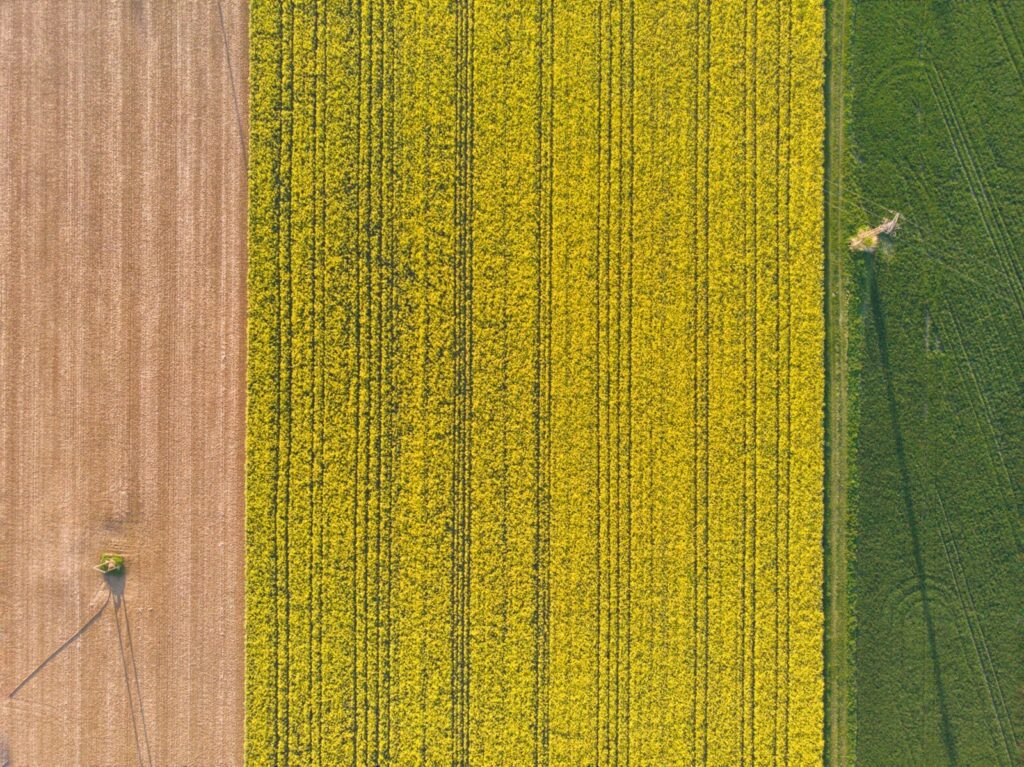
The Krishi Decision Support System combines satellite imagery, weather, soil and water data, crop data and scheme databases to produce digital crop maps, soil maps, yield estimates and drought and flood assessments, according to the PIB explainer. It also supports model-based yield assessment for crop insurance settlement. It is part of the Digital Agriculture Mission, which has an outlay of INR 2,817 crore.
The data foundation for AI in agriculture in India is the AgriStack registry and the Digital Crop Survey. The February 2026 explainer reported more than 7.63 crore Farmer IDs as of 27 November 2025, including 1.93 crore for women farmers, and a crop survey of 492 districts and over 23.5 crore plots in rabi 2024-25. The agriculture minister said on 24 October 2026 that the 11 crore Farmer ID target had been reached by the night of 23 October.
Plant breeding is a newer front for artificial intelligence. In the same 15 October 2026 announcement, Google DeepMind and Google.org said they were working with ICRISAT, the HudsonAlpha Institute for Biotechnology and the University of Washington on an open-access genetic atlas of sorghum, using machine learning on ICRISAT genebank samples. Google DeepMind is also funding a three-year postdoctoral fellowship at ICRISAT.
Robotics and autonomous control
In the UK, a new programme relevant to AI in agriculture is about robots rather than chatbots. On 9 October 2026 the Department for Business, Innovation, Science and Trade and the Cabinet Office announced Robotics Adoption Hubs backed by £40 million. One, HARVEST in Lincoln, covers the agri-food sector, with testbeds for arable farming, fruit, vegetables and food manufacturing. The government cites estimates that robotics and autonomous systems could add £150 billion to the UK economy by 2035 if adoption is maximised, against £6.4 billion at current adoption.
The University of Lincoln said it had secured £4.8 million as part of a £7.1 million investment to lead HARVEST, one of eight hubs chosen from 74 applications, funded through Innovate UK’s Robotics Adoption programme and UKRI. The money includes £500,000 for a robot test track at its Riseholme Park campus and a £1 million Acceleration Fund for agri-food robotics businesses. TAD reported on the Lincoln hub and its partners.
In protected cropping, control is moving to software. Source.ag announced on 9 October 2026 that it had acquired Optimal, a London startup whose AI controls greenhouse heating, ventilation, screens, lighting, CO2 and irrigation. Source says its own software runs in more than 500 greenhouses in 25 countries. TAD covered the Source.ag and Optimal deal.
In India, the PIB explainer says the Agricultural Engineering Division of ICAR’s Indian Agricultural Research Institute is developing robots for soil sampling, sowing, harvesting and crop surveillance. For drones, which overlap with this work, see our agriculture drone explainer.
Government programmes for AI in agriculture
India’s public effort runs through several channels. Besides the Digital Agriculture Mission and the advisory tools above, the Innovation and Agri-Entrepreneurship Development programme under the Rashtriya Krishi Vikas Yojana supports agri-startups, including those working on artificial intelligence. Between 2019-20 and 2025-26 it supported 2,282 startups with grants totalling INR 186.55 crore, offering up to INR 5 lakh at idea stage and up to INR 25 lakh at seed stage, the PIB explainer said.
Policy guidance came from a World Economic Forum playbook, Future Farming in India, subtitled A Playbook for Scaling Artificial Intelligence in Agriculture and published in August 2025 with IndiaAI, the Office of the Principal Scientific Adviser and BCG X. PIB says the government released it on 22 October 2025. Its IMPACT AI framework rests on three pillars, Enable, Create and Deliver, covering data-sharing frameworks and infrastructure, validation of solutions with start-ups and researchers, and delivery through extension systems.
Internationally, the UN Global Initiative on AI for Agri-Food Systems, coordinated by the International Telecommunication Union with FAO, IFAD and the World Food Programme, held its second meeting in New Delhi in October 2026, according to the Department of Telecommunications release of 10 October 2026. TAD covered the UN initiative’s Delhi meeting.
Farm-specific UK funding includes the Farming Innovation Programme of the Department for Environment, Food and Rural Affairs (Defra), delivered with Innovate UK. Defra said on 24 June 2026 that the programme would receive an additional £53 million, for a total of £123 million in the 2026/27 financial year, as part of an Industrial Strategy commitment to invest at least £200 million in agricultural innovation by 2030.
Within it, round 2 of the £20 million Farming Futures Automation and Robotics competition, for collaborative projects worth £500,000 to £2.5 million in agriculture, horticulture and forestry in England, was open for applications in August 2026, with a closing date of 30 September 2026. Projects funded in the 2023 round included a robotic mushroom harvester led by Agaricus Robotics (£772,425).
What the evidence shows on AI in agriculture
The most specific official data come from the monsoon pilot. Follow-up surveys in Madhya Pradesh and Bihar found that 31% to 52% of farmers changed planting decisions because of the forecasts, mainly land preparation, sowing dates and crop and input choices, according to the February 2026 PIB explainer. That measures changed behaviour, not yields or income, and the explainer does not give sample sizes.
The clearest peer-reviewed evidence on artificial intelligence and yields that TAD found comes from greenhouses. In a paper in the journal Sensors published on 11 November 2020, Wageningen University & Research scientists reported the second Autonomous Greenhouse Challenge: five international teams ran cherry tomato compartments remotely with artificial intelligence for about six months, against one compartment run by experienced human growers. All five AI-run compartments made a higher net profit than the human reference. Tencent funded the organisation of the challenge.
The AI teams’ edge over the human growers came mainly from costs, not yield. Output of class A fruit ranged from 12.9 to 14.4 kg per square metre, the human growers were among the three highest producers, and their lower profit came from higher energy and labour costs. All teams still used humans in the decision loop, with one compartment per team. The paper adds that in the first challenge, with cucumbers in 2018, the winning AI team raised output of sellable fruit by 6% and net profit by 17% against the reference growers.
The WEF playbook reports a Telangana pilot, Saagu Bagu, which gave four AI applications to around 7,000 chilli farmers. After one season, farmers reported a 21% improvement in yields, an 11% rise in unit prices and a 9% cut in fertiliser and pesticide use, earning an average of $800 more per acre per crop season. These are farmer-reported results from a project conducted in collaboration with the Forum and the state government, not an independent trial.
Many other figures on AI in agriculture are company or ministerial claims. Source.ag says Optimal’s system delivered 13% more yield with 27% less energy than a benchmark Dutch grower in a commercial greenhouse, a company figure that has not been independently verified. At the India launch of the World Bank’s World Development Report 2026 on 8 October 2026, Union Minister Ashwini Vaishnaw said sugarcane yields in Baramati rose by 40% with 30% less water and fertiliser; the release cites no study. TAD reported the Baramati claims at the time.
The PIB explainer also cites a Tamil Nadu case: a precision farming system from the start-up Farm Again, using solar-powered sensors to manage soil moisture, irrigation and fertiliser through a mobile platform. PIB says it doubled one grower’s coconut yields and has since reached over 3,500 farmers on more than 4,000 acres. That is a case study, not a controlled trial.
The World Bank’s own view is cautious. Its press release of 4 August 2026 said many AI pilots are under way but the bigger challenge is knowing which ones deliver results, and called for better evidence and clearer procurement and evaluation frameworks. The WEF playbook adds that fewer than 20% of Indian farmers use digital technologies, citing experts, and that institutional mechanisms for validating technology before it is deployed are very limited.
Data rights, liability and other risks
Who controls farm data is the central question for AI in agriculture. In India, the agriculture ministry told the Rajya Sabha on 7 August 2026 that AgriStack was developed in line with the Digital Personal Data Protection Act, 2023 and that farmers’ data is collected only with their consent. Sarvesh JP and Deepanjana Saha, writing in LiveLaw on 22 October 2026, argued that sharing registry data with firms for algorithmic credit scoring would be a new purpose needing fresh consent, and that farmers cannot see what drives a score.
Private platforms are setting their own terms. FBN said on 29 September 2026 that its planned AI Context Engine, which Google AI Futures Fund will help it develop, would keep farmers in full control of their data; its Norm adviser serves more than 140,000 members. Google’s 15 October announcement of API access did not say what data, if any, flows back from platforms that call its models. TAD covered the FBN and Google partnership.
The wider risks are set out by the World Bank: without deliberate action, artificial intelligence could widen gaps between countries, concentrate market power and create new risks for safety and rights, and if it embeds bias in government decisions or erodes data privacy, trust will be hard to recover. For autonomous systems, our view is that the open question is liability when software controls a crop.
Standards work has started. The Delhi meeting of the UN initiative promoted trustworthy and interoperable farmer-centric AI and cooperation on governance and standards, the DoT said.
What AI in agriculture means for agritech, input and machinery companies
For agritech companies selling artificial intelligence products, we see the government as both a competitor and a channel. Public advisers such as Kisan e-Mitra and Bharat-VISTAAR set a baseline, so paid products need to show results beyond them. Our reading is that the best openings are as integrators, as Amnex is in Gujarat, or as specialist tools that plug into public platforms. Firms in our farm software and data category should expect buyers to ask for trial design and control groups.
For seed, fertiliser and crop protection companies, artificial intelligence advisers increasingly sit between the product and the farmer. When a chatbot or an agent recommends a pest control or a seed variety, how it ranks options matters to sales. Our view is that input makers should ask platforms how recommendations are generated, and should note that NPSS and public advisers already give crop protection guidance at national scale.
For machinery and drone makers, the UK hubs offer advice, testing and demonstration, HARVEST adds a £1 million Acceleration Fund, and Defra’s competition funds collaborative development. The Source.ag deal puts control software at the centre of the greenhouse. Suppliers in our precision hardware category will face questions on data ownership, interoperability with farm software and who is liable when an autonomous system fails. For context on field-level technology, see our precision agriculture guide.
For insurers and lenders, YES-TECH and CROPIC show where public data is heading: technology-based yield estimates with a guaranteed minimum weight. Our view is that insurers that build modelling capability will price and settle faster, while those that do not will depend on government models. More coverage sits on our Precision and digital desk.
AI in agriculture: frequently asked questions
What are the main uses of AI in agriculture?
The main uses of AI in agriculture are advisory chatbots, image-based pest and disease detection, yield estimation for crop insurance, satellite and weather-based crop monitoring, and robotics and autonomous control of machines and greenhouses. In India, public examples include Kisan e-Mitra, the National Pest Surveillance System and YES-TECH under PMFBY. Machine learning is also being applied to plant breeding data.
What is Bharat-VISTAAR?
Bharat-VISTAAR is a multilingual AI tool proposed in the Union Budget 2026-27 to integrate the AgriStack portals and the ICAR package of agricultural practices with AI systems for advisory services. By July 2026 it had served over 3 lakh farmers and addressed more than 72 lakh farmer queries, according to a PIB backgrounder of 12 August 2026.
How is AI used in crop insurance in India?
Under PMFBY, YES-TECH uses remote sensing and AI-driven analytics to estimate yields, with a minimum 30% weight for technology-based estimates. It covers paddy, wheat and soybean, was implemented in 12 states across 344 districts in 2025-26, and Madhya Pradesh gave technology-based yield 100% weight that year. CROPIC uses geotagged crop photographs to assess damage.
What is the UK doing on artificial intelligence and robotics in farming?
On 9 October 2026 the UK government announced Robotics Adoption Hubs backed by £40 million. HARVEST, led by the University of Lincoln with £4.8 million of a £7.1 million investment, covers agri-food, with a £500,000 robot test track and a £1 million Acceleration Fund. Separately, Defra’s Farming Innovation Programme has a total of £123 million for 2026/27, and round 2 of its £20 million automation and robotics competition had a closing date of 30 September 2026.
Is there evidence that AI in agriculture raises yields?
Evidence is limited. A peer-reviewed 2020 study of a Dutch greenhouse trial found five AI-run compartments all made more profit than human growers, though the humans’ yields were among the highest. Surveys in Madhya Pradesh and Bihar found 31% to 52% of farmers changed planting decisions after AI monsoon forecasts. A Telangana chilli pilot reported a 21% yield improvement, but those were farmer-reported results. Source.ag’s greenhouse figures and the Baramati sugarcane figures are company or ministerial statements without published methodology.
Who owns the farm data used by artificial intelligence tools?
It depends on the system. India’s agriculture ministry says AgriStack data is collected only with farmers’ consent and that states own their registries. Private platforms set their own terms: FBN says its planned AI Context Engine will keep farmers in full control of their data. Writers in LiveLaw have argued that sharing registry data for credit scoring would need fresh consent.