Precision agriculture is the practice of managing a field, herd or crop according to measured differences within it, rather than treating it as uniform. For machinery makers, software firms and input companies, it is also a market: guidance receivers, yield monitors, variable rate controllers, sensors, drones and the data services that connect them.
This explainer sets out the accepted definition, the main technologies, the latest official adoption figures for the United States and England, why small Indian farms are a different case, and what precision farming means for suppliers. Figures are dated to the survey or filing they come from, as of 31 October 2026.
What precision agriculture means
The International Society of Precision Agriculture (ISPA) publishes a formal definition, revised in January 2024. It describes precision agriculture as a management strategy that gathers, processes and analyses data that varies over time, across space and between individual plants and animals, and combines it with other information to support management decisions according to estimated variability.
The stated aims are better resource use efficiency, productivity, quality, profitability and sustainability. ISPA also publishes a shorter version: a management strategy that takes account of temporal and spatial variability to improve the sustainability of production. Neither version names a technology. Precision agriculture is a way of making decisions, and the hardware and software are tools for it.
The distinction matters commercially. A farm can own a GPS receiver and still manage every field uniformly, and a farm with no electronics can practise a form of precision farming by sampling soils zone by zone. Official surveys therefore count specific technologies or practices, not precision agriculture as a whole, and their numbers are not interchangeable.
The US Department of Agriculture’s Economic Research Service (ERS) uses a wider term, digital agriculture, for the same family of tools plus data analytics, automated processes and artificial intelligence. Its 2023 report says digitalisation can be tracked partly by examining farmers’ use of established and emerging technologies, which is how most official adoption statistics are built.
The main precision farming technologies
ERS groups the core tools into data collection, decision support and data-driven equipment in its report Precision Agriculture in the Digital Era (EIB-248, 22 February 2023). Together they form a loop: measure variability, map it, then vary the operation to match.
Guidance and auto-steer
ERS describes guidance systems as equipment that reduces overlaps or skips between passes, either by showing the operator where to steer, for example with a lightbar, or by automating nearly all steering. Lightbars arrived in the mid-1990s and full automation in the late 1990s, it says. Positioning comes from global navigation satellite systems (GNSS). In the ERS data, guidance is the most widely adopted of the tools tracked.
Yield monitors and yield maps
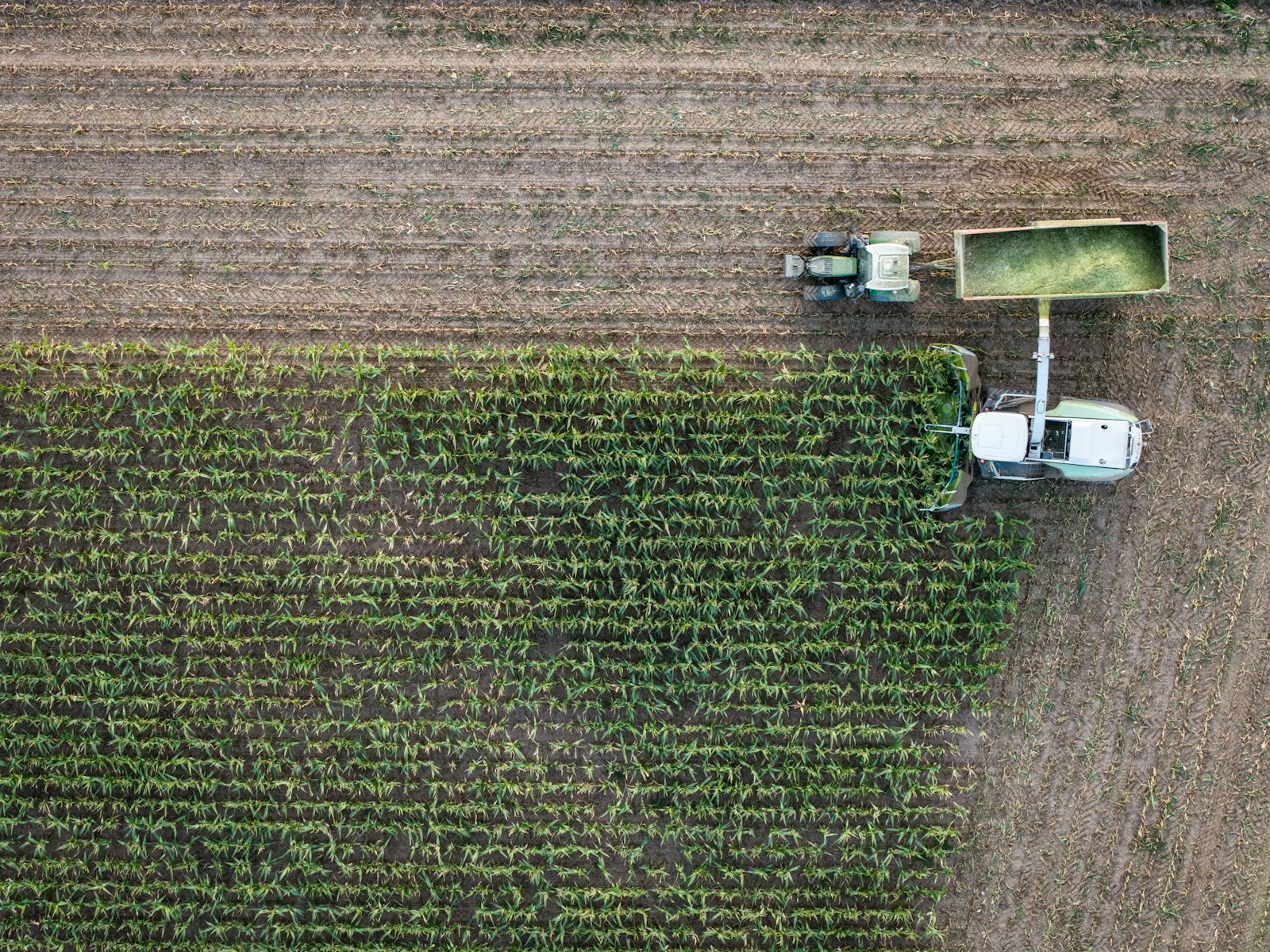
ERS describes a yield monitor as three parts: a mass flow sensor that measures grain flow, a moisture sensor, and a positioning receiver that records where each reading was taken. Geo-referenced readings become a yield map, which shows how output varied across a field in a season.
Soil maps, variable rate and section control
Soil maps display physical and chemical attributes of soils; ERS says precision soil sampling takes cores from grids or other small areas for laboratory analysis. Variable rate technology (VRT), commercialised in 1995 according to ERS, applies seed, lime, fertiliser or pesticides at rates that can change over short distances. Automated section control, from 2003, shuts off a boom section, sprayer nozzle or planter row where that part of the field needs no input. Controlled traffic farming uses tramlines so machines return to the same tracks.
Drones, aircraft and satellite imagery
ERS says imagery from drones, aircraft or satellites is used mostly for crop mapping, livestock monitoring, land surveying, crop spraying and crop dusting. India’s rules for spraying drones are covered in our agriculture drone explainer.
Precision agriculture adoption in the United States
ERS draws on the Agricultural Resource Management Survey (ARMS), run with the National Agricultural Statistics Service, which covers different crops in different years. EIB-248 uses the most recent surveys for each crop: rice (2013), corn (2016), winter wheat (2017), soybeans (2018), and cotton and sorghum (2019). Later USDA releases count farms rather than acres. The NASS Technology Use report of 1 August 2025 found that 22% of US farms used precision agriculture practices to manage crops or livestock in 2025, down from 27% in 2023.
Guidance is the most common tool. Auto-steer and guidance systems were used on 5.3% of planted corn acres in 2001 and 58% in 2016, and estimates for 2019 put adoption at 72.9% of sorghum and 64.5% of cotton acres. In 2019, GPS applications were used on 40% of all US farm and ranchland acreage for on-farm production, the report says.
Other tools lag. Variable rate technology was used on 37.4% of corn acres in 2016, 25.3% of soybean acres in 2018, 22.7% of cotton and 13.9% of sorghum acres in 2019, and 18.8% of winter wheat acres in 2017. Soil maps covered 21.5% of corn acres in 2016 and 5.6% of winter wheat acres in 2017. Drone, aircraft or satellite imagery ranged from 2.8% of cotton acres in 2019 to 9.8% of soybean acres in 2018.
Scale drives adoption
Farm size is the clearest pattern. ERS says at least half of larger row crop farms use yield maps, soil maps, VRT or guidance, while, except for cotton, fewer than 25% of the smallest farms use any of the four. An ERS Amber Waves article of April 2023 gives an example: 10% of corn farms with 200 acres or fewer used guidance systems in 2016, against 73% of corn farms with 1,725 acres or more.
ERS attributes part of this to scale benefits, since adjustment costs can be spread over more output on a larger farm. It lists those costs as subscription fees, training, maintenance and replacement, alongside field topography, soil type and farmers’ risk preferences. ERS’s America’s Farms and Ranches at a Glance: 2024 Edition (EIB-283, 10 December 2024) found the same gap in 2023 survey data: among farms that harvested crops, guidance autosteering was used on 9% of small, 52% of midsize and 70% of large-scale farms, and variable rate technology on 5%, 32% and 45%.
Precision farming in England: the Defra Farm Practices Survey
England’s main official source is Defra’s Farm Practices Survey. The February 2026 edition, published on 11 June 2026, went to about 7,000 holdings with a response rate of about 22%, and its results represent almost 55,000 commercial holdings above minimum size thresholds. Its topics usually relate to farming’s environmental impact, so it asks about precision farming within questions on spreaders and emissions, not as a full technology census.
The accompanying time series shows that 41% of holdings had fertiliser spreaders that are computer controlled with variable rate application in 2026, up from 23% in 2016 and 32% in 2023. For manure or slurry spreaders the figure was 19% in 2026, against 2% in 2016. Some 51% of holdings said none of their spreaders had it.
Asked what they were doing to reduce greenhouse gas emissions, 14% of all holdings said they were using precision farming techniques in 2026, against 13% in 2024 and 15% in 2025. Among the 47% of farmers taking any action on emissions, the share using precision farming was 25%. Defra notes that the question gained new response options in recent years, so comparisons with earlier years need care.
Government money is going into the next layer of automation. On 9 October 2026 the UK government said it was rolling out eight Robotics Adoption Hubs backed by £40 million, including HARVEST, based in Lincoln, with testbeds covering arable farming, fruit, vegetables and food manufacturing. Our report on the Lincoln hub has the details.
Why precision agriculture looks different on small Indian farms
The US and English data show adoption rising with farm size, and India’s farms are small. According to the Agricultural Census 2015-16, as summarised by PRS Legislative Research in its analysis of the 2026-27 agriculture budget, around 68% of operational holdings were marginal, under one hectare, and covered 24% of the operated area. In our view, equipment designed to pay back over hundreds of acres has little to work with on a plot that size.
The Economic Survey 2025-26 says fragmented landholdings and rising labour shortages continue to hinder mechanisation, and calls for appropriate, affordable machinery and collective ownership through FPOs, primary agricultural credit societies and self-help groups. Between 2014-15 and 30 October 2025, 25,689 custom hiring centres were set up under the Sub-Mission on Agricultural Mechanisation, it says.
In our analysis, that shapes how precision farming reaches Indian growers: as a service bought by the acre, or as public data, rather than as equipment owned by each farmer. Spraying drones are the clearest case. In a Lok Sabha reply on 16 December 2025, the agriculture ministry said 2,122 drones had been approved for individual farmers and custom hiring centres under the sub-mission between 2023-24 and 30 November 2025.
Public data as precision agriculture infrastructure in India
The state is building the data layer. The Cabinet approved the Digital Agriculture Mission on 2 September 2024 with an outlay of INR 2,817 crore, including a central share of INR 1,940 crore, to build three digital public infrastructures: AgriStack, the Krishi Decision Support System and Soil Profile Mapping. Our AgriStack explainer covers the farmer registry.
A government backgrounder of 12 August 2026 said more than 10.31 crore Farmer IDs had been created as on 3 August 2026, and that the Digital Crop Survey in rabi 2025-26 covered more than 31.3 crore plots in 648 districts. Plot-level crop and land records are the kind of base data that precision agriculture services need, although the backgrounder does not say how many private services use them.
Machinery makers are adapting precision features to smaller tractors. Mahindra said on 12 October 2026 that its MaxSeeder, a precision zero-till seeder made under licence from Clean Seed Technologies of Canada, can be run with a 35 HP tractor or above, and that an electronic control unit, controlled from a phone app, dispenses seed, DAP and urea based on field requirements. Our report on the MaxSeeder has more.
Business models and costs in precision agriculture
In our reading, four commercial models run through the filings and surveys. The first is the equipment bundle: guidance, displays, connectivity and software sold as part of a new machine. The second is the retrofit kit added to an existing fleet. The third is the subscription, where the farmer pays each year for corrections, data services or software. The fourth is the service contract, where a contractor or service provider owns the kit and sells the operation.
English data show how large the service route can be. In the February 2026 survey, fertiliser was spread solely by a contractor on 19% of holdings and manure or slurry on 27%. In India, custom hiring centres and drone service providers play that role for smaller farms. In each case the buyer of precision agriculture technology may be a contractor, a cooperative or a service firm rather than the farmer.
Published cost data are thin. EIB-248 gives survey averages for 2018 soybean fields: $20,165 to replace a guidance system plus a $1,154 annual fee, $8,051 to replace a yield monitor plus $1,041 a year, and a $5,630 premium paid for variable rate equipment. ERS says costs differ by manufacturer and that bundling makes purchase prices hard to estimate. Defra’s survey gives no prices, and the filings reviewed give no list prices.
Connectivity and data security add to the bill. CNH lists among its summary risk factors that unauthorised access to, or manipulation of, its connected products could reduce customer confidence, and that changes in privacy laws could disrupt its business. Deere describes its Operations Center as a digital management system that allows customers to access farm and jobsite information through their devices.
What precision agriculture means for machinery, software and input companies
Machinery makers
In The Agrotech Daily’s analysis, precision agriculture is now a reporting line for the largest equipment groups. Deere’s annual report for the year to 2 November 2025 shows its Production and Precision Agriculture segment generated net sales of $17,311 million, 45% of equipment operations net sales. Deere lists slower than expected customer adoption of some precision technology solutions among its risks. See our Deere profile.
CNH says in its 2025 annual report that it acquired Raven Industries in 2021, and Hemisphere GNSS and the machine vision company Augmenta in 2023, and that precision technology is integrated with its equipment and also sold as aftermarket parts. AGCO’s 2025 annual report says it owns 85% of the PTx Trimble joint venture formed on 1 April 2024 and has a goal of $2 billion in precision ag revenue by 2029. See our CNH and AGCO profiles.
Software and data firms
For software firms, the data layer is the product, and the main commercial questions are who owns field data, whether it moves between machine brands, and who pays for it. AGCO’s stated aim to sell precision tools regardless of machine brand, and CNH’s aftermarket route, both point to a mixed-fleet market. Suppliers are listed in our precision hardware and farm software and data categories.
Input companies
For seed, fertiliser and crop protection companies, variable rate and section control change where and how much product is applied. ERS says VRT may make applications more efficient without a loss of yield and could lower total production costs. For input sellers, that shifts the sale from volume towards prescriptions, data and service, and makes compatibility with application machinery a commercial issue.
England shows where the base of compatible machines is growing fastest. The share of holdings with variable rate control on fertiliser spreaders rose from 32% in 2023 to 40% in 2024 and 41% in 2026. For fertiliser suppliers and spreader makers, that is a measurable population of machines able to apply a variable prescription.
What is still unsettled
Several gaps limit what can be said about precision farming with confidence, as of 31 October 2026.
- US data: ERS acreage figures by crop run only to 2019, and the newer USDA figures for 2023 and 2025 count farms, so the two series are not directly comparable.
- England coverage: Defra’s survey asks about precision farming within environmental questions and changed its response options in recent years.
- India measurement: The Agrotech Daily found no official national survey of precision agriculture adoption in India; public figures cover schemes such as drones, custom hiring centres and digital crop surveys.
- Costs and returns: the ERS cost averages come from 2018 and 2019 surveys, and none of the official sources reviewed gives payback periods.
- Data rights: the filings reviewed flag privacy law and the security of connected products as risks, and official statistics do not cover how field data moves between platforms.
For suppliers, these gaps mean market sizing rests on company disclosures and private surveys more than on official statistics. Our Precision and digital desk follows new data as it is published.
Precision agriculture: frequently asked questions
What is the official definition of precision agriculture?
The International Society of Precision Agriculture, in a definition revised in January 2024, describes it as a management strategy that gathers, processes and analyses temporal, spatial and individual plant and animal data, combines it with other information and supports decisions according to estimated variability. The aim is better resource use efficiency, productivity, quality, profitability and sustainability. The definition names no particular technology.
Which precision farming technology is most widely used?
Guidance and auto-steer. In US Department of Agriculture survey data, auto-steer and guidance were used on 58% of planted corn acres in 2016, up from 5.3% in 2001, and estimates for 2019 put use at 72.9% of sorghum and 64.5% of cotton acres. In 2023, 70% of large-scale crop farms used guidance autosteering. Variable rate technology and soil maps are used on smaller shares of acreage.
How many farms in England use precision farming?
Defra’s Farm Practices Survey of February 2026 found that 41% of holdings had fertiliser spreaders with computer-controlled variable rate application, and 14% of all holdings cited precision farming techniques as an action to reduce greenhouse gas emissions. The survey went to about 7,000 holdings with a response rate of about 22%.
Why is precision agriculture adoption lower on small farms?
US data show adoption rising with farm size because the costs of equipment, subscriptions, training and maintenance are spread over more output on larger farms. In 2016, 10% of US corn farms with 200 acres or fewer used guidance systems, against 73% of those with 1,725 acres or more. In India, around 68% of holdings were under one hectare in 2015-16.
How does precision agriculture reach farmers in India?
Mainly through services and public data rather than individual ownership. Custom hiring centres, 25,689 of which were set up under the mechanisation sub-mission between 2014-15 and October 2025, rent out machinery including drones. The Digital Agriculture Mission, approved in September 2024 with INR 2,817 crore, is building AgriStack, a crop decision support system and soil profile maps.
Which companies sell precision agriculture technology?
The large equipment groups report it directly. Deere’s Production and Precision Agriculture segment had net sales of $17,311 million in the year to 2 November 2025. CNH bought Raven in 2021 and Hemisphere GNSS and Augmenta in 2023. AGCO owns 85% of PTx Trimble and targets $2 billion in precision ag revenue by 2029.