When Jeremy Clarkson trades his Lamborghini tractor for a £310,000 autonomous machine, people notice. Not just farmers scanning trade journals for the latest precision agriculture equipment, but millions of Sunday Times readers, aspiring smallholders, and anyone who’s watched his surprisingly successful foray into British farming on Amazon Prime.
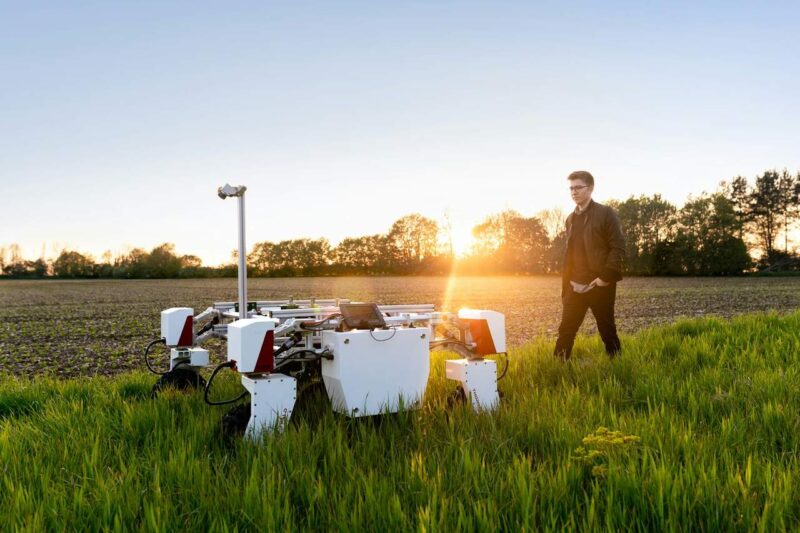
The machine in question is the AgBot T2, a crawler-tracked autonomous tractor manufactured by Dutch company AgXeed. It’s currently working the fields at Diddly Squat Farm in Oxfordshire, and whether Clarkson intended it or not, his adoption of the technology has thrust autonomous farming into mainstream conversation in a way that decades of agricultural trade shows never managed.
This matters because whilst the agricultural technology sector has been developing autonomous solutions for years, public awareness and political support often hinge on visibility. When a high-profile farmer invests in technology that promises to address labour shortages, reduce environmental impact, and improve efficiency, it shifts the conversation from “if” to “when” for many watching from the sidelines.
The Problem Autonomous Technology Promises to Solve
British agriculture faces a labour crisis that’s been building for years. The average age of UK farmers now sits at 59, post-Brexit workforce restrictions have tightened access to seasonal labour, and young people show limited interest in entering the sector. Meanwhile, the work itself remains physically demanding, repetitive, and often conducted in weather conditions that range from uncomfortable to genuinely unpleasant.
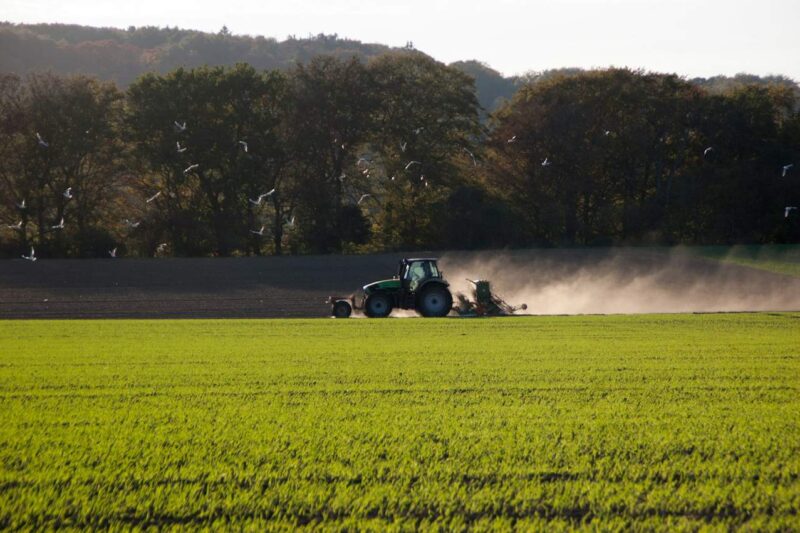
Traditional cultivating and seeding operations require extended hours of attention to maintain straight passes, consistent depth, and proper coverage. A 200-acre field preparation and planting operation typically demands 30 hours of operator time, much of it spent managing equipment across repetitive passes whilst monitoring seed rates, cultivation depth, and overall coverage.
Human operators get tired. They lose concentration. They make small errors that compound across hundreds of acres. They need breaks, refreshment stops, and eventually, sleep. Autonomous systems don’t share these limitations.
Understanding the AgBot T2
The AgBot T2 represents a fundamentally different approach to field operations rather than simply being a conventional tractor with automated steering.
Power comes from a 156-horsepower Deutz diesel engine connected to an electric generator. The machine runs on Zuidberg crawler tracks measuring 610mm wide rather than conventional wheels. This design choice serves a specific purpose: distributing the machine’s 7.8-tonne weight across a larger surface area to reduce soil compaction to approximately 0.3 bar.
Soil compaction matters more than many non-farmers realize. When heavy equipment compresses soil structure, it reduces pore space, limits water infiltration, restricts root development, and ultimately decreases crop yields. Conventional wheeled tractors can exert significantly higher pressure on soil, creating long-term fertility problems that require years to remedy.
The machine’s autonomous operation relies on GPS guidance accurate to 2.5cm. This precision eliminates common operator errors: missed patches, overlapping passes, continuing operations with empty seed hoppers, and the gradual drift that occurs when humans try to maintain perfect straight lines across long field runs.
Safety systems include lidar sensors covering a 30-metre radius, ultrasonic and radar sensors in the front bumper, and obstacle detection that immediately halts operations if anything unexpected enters the working area. The machine integrates with AgXeed’s TraxWise cloud platform, allowing farmers to plan routes, monitor operations remotely, and maintain automatic documentation of all field activities.
At 75% engine load, the AgBot can operate continuously for 20 hours between refuelling. Unlike human operators, it can work through darkness, maintaining the same precision at midnight that it demonstrates at midday.
AgXeed currently offers three models: the tracked T2 (available in 155hp and the newer 230hp T2 7 Series launched at Agritechnica 2025), a four-wheeled W4 2 Series (75hp), and a three-wheeled W3 2 Series (75hp) designed for orchards and specialty crops.
The Economics That Make Farmers Hesitate
The AgBot T2’s retail price ranges from £300,000 to £320,000 depending on specification. That’s roughly double the cost of a comparable conventional tractor, and in an industry where net farm income has been under sustained pressure for years, it represents a formidable investment barrier.
Peter Robinson, AgXeed’s head of sales, has acknowledged this reality publicly. The current economic climate in British farming makes large capital investments challenging regardless of their long-term benefits.
However, the calculation involves more than simple purchase price comparison. AgXeed offers nine-month lease arrangements, allowing farmers to trial autonomous technology before committing to purchase. More significantly, the UK government’s Improving Farm Productivity grant, which accepted applications through March 2024, offered to cover up to 50% of costs for robotic and autonomous equipment, with grants ranging from £25,000 to £500,000.
For farmers who secured grant funding, the effective cost drops to £150,000-£160,000. When weighed against labour savings, reduced input costs from precision application, fuel efficiency from optimized routing, and potential yield improvements from consistent field operations, the economics begin to shift.
ASC Autonomy, AgXeed’s partner for England and Wales, suggests their clients achieve labour savings up to 90% and total cost reductions of 25-35% compared to conventional tractor operations. These figures require verification across multiple seasons and farm types, but they indicate the scale of potential efficiency gains.
The Labour Displacement Question
Not everyone celebrates automation’s arrival. Reports suggest that farm staff at Diddly Squat initially viewed the AgBot with concern about job security.
This anxiety echoes across British agriculture. The NFU has welcomed technological advancement whilst emphasizing that affordability and accessibility remain crucial considerations. The prospect of automation displacing agricultural workers creates genuine concern in an industry already grappling with workforce challenges.
Yet the counterargument holds substantial weight. The UK agricultural sector doesn’t face a problem of too many workers competing for too few positions. It faces chronic labour shortages that prevent farms from operating at full capacity. Autonomous technology doesn’t steal jobs that humans want; it fills vacancies that increasingly cannot be filled through conventional hiring.
The more sophisticated deployment model involves using autonomous equipment to handle repetitive, time-intensive operations whilst human operators focus on tasks requiring judgment, problem-solving, and adaptability. A contractor with access to autonomous equipment could set it working at one location whilst personally operating conventional machinery elsewhere, effectively doubling operational capacity without doubling labour costs.
Market Development and Competition
AgXeed currently operates just eight machines in the UK compared to 112 globally. Production capacity sits at two units per week from their Dutch manufacturing facility. This scarcity reflects both the early-stage nature of the market and the careful, methodical approach required when introducing genuinely transformative technology.
Competition is emerging rapidly. Monarch Tractor recently secured $133 million (£104 million) in Series C funding for its electric autonomous platform. John Deere has introduced retrofit kits allowing existing 8R and 9R Series tractors to operate autonomously. Case IH, Fendt, and several smaller manufacturers have announced autonomous development programs.
Market analysis projects the autonomous agricultural vehicle sector in the UK will grow from £963 million in 2023 to £2.8 billion by 2032, representing a compound annual growth rate of 12.71%. These projections depend on several variables: continued government support through grants and favorable regulation, demonstration of reliable return on investment across diverse farm types, and resolution of technological challenges that emerge during real-world deployment.
What Celebrity Adoption Actually Changes
The agricultural technology industry has spent decades developing autonomous solutions. Engineers have refined GPS accuracy, improved obstacle detection, optimized power systems, and created user interfaces that make sophisticated technology accessible to operators who might not consider themselves particularly tech-savvy.
What the industry has struggled with is visibility outside its immediate circle. Precision agriculture remains largely invisible to the general public, which means it remains invisible to policymakers, investors, and the next generation of potential farmers who might be attracted to an industry embracing cutting-edge technology.
When a celebrity farmer publicly adopts autonomous equipment and discusses it in mainstream media, several things happen simultaneously. Public awareness increases. Political conversations about agricultural innovation gain concrete examples. Investment capital begins paying attention to a sector it might have previously overlooked. And crucially, farming itself begins to shed some of its outdated image.
The true test won’t be immediate sales figures. It’ll be whether autonomous technology proves reliable, cost-effective, and practical across the diverse conditions British farming presents. It’ll be whether the next generation of farmers sees agricultural technology as an opportunity rather than a threat. And it’ll be whether the broader public understands that food production increasingly relies on precision, efficiency, and innovation rather than romantic notions of pastoral simplicity.
The Practical Reality Check
Autonomous farming technology isn’t magic. It’s engineering solving practical problems, complete with trade-offs, teething troubles, and unexpected benefits that only emerge through real-world implementation.
Harvest results will ultimately determine whether autonomous cultivation and seeding deliver measurable advantages. Those results will be complicated by weather variables, soil conditions, seed genetics, pest pressure, and dozens of other factors that make agricultural outcome attribution notoriously difficult.
What autonomous technology can demonstrably deliver is consistency. Every pass at exactly the right depth. Every seed placed at precisely the correct spacing. Every operation documented automatically for compliance and optimization. No fatigue-induced errors. No missed sections requiring remedial work.
Whether that consistency translates into yield improvements sufficient to justify the investment remains the critical question each farmer must answer for their specific circumstances.
The Bigger Picture
British agriculture stands at an inflection point. Traditional methods face increasing pressure from labour shortages, environmental regulations, margin compression, and climate uncertainty. The industry must become more efficient, more sustainable, and more appealing to a younger generation that currently shows limited interest in farming careers.
Autonomous technology represents one pathway toward addressing these challenges. It won’t solve everything. It won’t suit every farm size or type. It won’t eliminate the need for skilled human operators who understand agronomy, equipment maintenance, and operational planning.
But it might make farming viable for operations that would otherwise struggle to find sufficient labour. It might reduce environmental impact through precision that humans simply cannot match across extended operations. It might attract technically-minded young people who see agriculture as a sector embracing innovation rather than resisting it.
The fact that this conversation now reaches beyond agricultural trade publications into mainstream media represents progress in itself. Whether autonomous tractors become standard equipment or remain niche solutions for large-scale operations, the industry benefits from public awareness that farming involves sophisticated technology addressing complex challenges.
For AgXeed, the exposure that comes with high-profile adoption carries both opportunity and risk. If the technology performs reliably and delivers measurable benefits, the endorsement effect could accelerate market adoption significantly. If it encounters problems or fails to justify its cost premium, that same visibility could damage broader autonomous technology adoption across the sector.
Either way, the experiment now unfolds in public view. Farmers watching from neighbouring counties will draw their own conclusions based on demonstrated results rather than manufacturer claims. That’s probably the healthiest way for genuinely transformative technology to prove its worth.
Looking Forward
The autonomous agricultural vehicle market continues developing rapidly. Battery technology improvements may eventually enable fully electric autonomous tractors that eliminate diesel dependency entirely. Artificial intelligence advances could allow autonomous systems to make increasingly sophisticated operational decisions currently requiring human judgment. Fleet management systems might coordinate multiple autonomous machines working cooperatively across large estates.
These developments remain speculative. What’s concrete is that autonomous technology has moved from research facilities and demonstration plots into commercial operation on working farms across Britain. The number of machines remains small, the costs remain high, and numerous practical questions await answers that only extended real-world deployment can provide.
But the trajectory seems clear. Autonomous agricultural equipment will become increasingly common, increasingly capable, and increasingly affordable as production scales and technology matures. The question isn’t whether autonomous tractors will become part of British farming, but how quickly adoption will occur and which farm types will benefit most.
For now, one of Britain’s most visible farmers has made his bet. Whether that proves shrewd investment or expensive experiment, the attention it’s generated has already changed the conversation about agriculture’s technological future.
And in an industry often resistant to change, that visibility might prove the most valuable contribution of all.
Technical specifications sourced from AgXeed public documentation and manufacturer specifications. Market projections from agricultural technology industry analysis reports. Grant information from UK government agricultural funding programs.