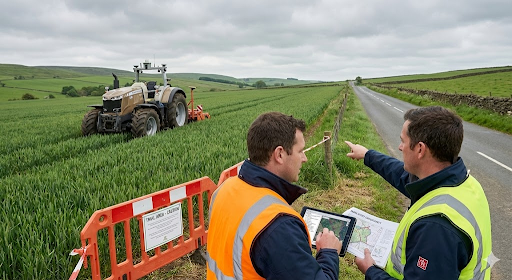
Autonomous agricultural machinery is transforming British farming operations, yet the United Kingdom lacks dedicated legislation specifically governing farm robotics and self-driving equipment operating on private land. Whilst the Automated Vehicles Act 2024 establishes frameworks for road-going autonomous vehicles, agricultural equipment operating in fields remains regulated through existing workplace safety legislation, voluntary industry standards, and emerging codes of practice.
This regulatory gap creates both opportunities and uncertainties for UK farmers considering autonomous technology adoption. Understanding current oversight mechanisms, compliance requirements, and industry-led safety frameworks proves essential for farms deploying robotic equipment whilst navigating responsibilities around worker safety, public access, and equipment operation.
Current Regulatory Framework for Agricultural Machinery
The Health and Safety Executive maintains primary regulatory authority for agricultural workplace safety in the United Kingdom, including machinery operation. HSE oversight applies to all agricultural equipment whether human-operated, remotely controlled, or fully autonomous, operating under existing Health and Safety at Work legislation rather than technology-specific rules.
The Supply of Machinery (Safety) Regulations 2008, implementing the Machinery Directive, establish requirements for manufacturers and suppliers of new agricultural machinery. These regulations require equipment suppliers to identify hazards, design machines accounting for risk assessments, meet essential health and safety requirements, and provide declarations of conformity with CE marking.
Agricultural tractors remain exempt from certain machinery regulations where EU directives addressed relevant requirements through tractor-specific type approval systems. This exemption continues under retained EU law following Brexit, though specific provisions may evolve as UK regulations diverge from EU standards.
The Provision and Use of Work Equipment Regulations 1998 govern equipment usage on farms, requiring employers to ensure machinery remains suitable for intended purposes, properly maintained, and operated by trained personnel. These general requirements apply regardless of automation level, placing responsibility on farm operators for safe equipment deployment.
BS 8646:2023 Code of Practice
The British Standards Institution published BS 8646:2023 in June 2023, establishing the first European code of practice specifically addressing autonomous mobile machinery in agriculture and horticulture. Whilst not legally mandated, this standard represents industry consensus on safety requirements and operational best practices for agricultural autonomous equipment.
The code provides guidance covering safety and risk management processes applicable to farming operations, instructions and training requirements for safe operation and maintenance of autonomous mobile machinery, and farm planning advice including hazard controls and emergency preparedness. Development involved representatives from Harper Adams University, JCB, John Deere, the Agricultural Engineers Association, HSE, National Farmers Union, and other agricultural stakeholders.
BS 8646:2023 clarifies roles and responsibilities for equipment owners and operators, designers and manufacturers, and importers and distributors, reducing uncertainties around accountability when autonomous systems operate without continuous human supervision. The standard costs £198 from BSI and comprises 26 pages of guidance applicable to various autonomous agricultural equipment types.
Compliance with BS 8646:2023 remains voluntary, though the standard relates to relevant legal requirements under Health and Safety at Work legislation. Following incidents, investigators, insurance companies, and legal entities examine whether businesses followed code recommendations, potentially influencing liability determinations and claims outcomes.
The code’s existence encourages wider autonomous machinery adoption, particularly among smaller farming enterprises previously uncertain about safety protocols and compliance expectations. By establishing clear operational frameworks, BS 8646:2023 enables farmers to demonstrate due diligence in autonomous equipment deployment whilst supporting responsible technology integration.
ISO 18497:2018 International Safety Standard
ISO 18497:2018 specifies design principles for highly automated agricultural machines and vehicles during field operations. This international standard addresses safety requirements for agricultural tractors, tractor-implement systems, and self-propelled machinery with functions allowing highly automated operations.
The standard provides principles for design, verification, validation, and information provision ensuring appropriate safety levels for highly automated agricultural machines. Whilst detailed specification requirements depend on specific machines and operating conditions, ISO 18497:2018 establishes foundational safety concepts applicable across agricultural autonomous systems.
ISO standards remain voluntary in the United Kingdom unless incorporated into regulatory requirements or cited in compliance frameworks. However, manufacturers following ISO 18497:2018 demonstrate commitment to internationally recognised safety principles, potentially supporting product certification and liability protection during incident investigations.
Liability and Insurance Considerations
UK law currently provides no specific liability framework for autonomous agricultural equipment accidents, leaving responsibility allocation governed by general principles of tort law, contract law, and employer liability. This contrasts sharply with the Automated Vehicles Act 2024, which explicitly transfers liability for road vehicle autonomous operation failures from operators to manufacturers.
For farm autonomous equipment, liability typically remains with farm operators as equipment owners and employers responsible for workplace safety. Operators bear responsibility for appropriate equipment selection, proper deployment within operational parameters, adequate training provision, and maintenance of equipment in safe working condition.
Manufacturers face potential liability under product liability law if equipment defects cause injuries or damage. However, establishing manufacturing defects versus operator misuse often proves complex with autonomous systems where improper deployment, inadequate training, or failure to follow operational guidelines contribute to incidents.
Agricultural liability insurance typically covers injuries to third parties or employees resulting from farming operations. Standard farm insurance policies may require endorsements or specific provisions covering autonomous equipment, as underwriters assess different risk profiles compared to conventional machinery.
Insurers increasingly request information about autonomous equipment deployment including equipment specifications, safety features and certifications, operator training protocols, and adherence to codes of practice like BS 8646:2023. Demonstrating systematic risk management and following industry standards supports favourable underwriting terms.
Farm operators deploying autonomous equipment should verify insurance coverage explicitly extends to robotic operations, understand any exclusions or limitations specific to autonomous systems, document training and operational procedures systematically, and maintain detailed operational logs supporting liability defences if incidents occur.
HSE Workplace Safety Requirements
The Health and Safety Executive requires employers to protect worker safety around all agricultural machinery including autonomous equipment. General workplace safety obligations apply regardless of automation level, though autonomous systems introduce unique considerations around human-machine interaction and operational supervision.
Risk assessments must identify hazards specific to autonomous equipment operation including unexpected machine movements, equipment operating in areas with workers present, cyber security vulnerabilities affecting safety systems, and interaction between autonomous machines and conventional equipment.
Control measures should establish operational zones clearly delineated and communicated, implement geofencing preventing equipment entering unsuitable areas, provide adequate supervision during commissioning and operation, and train all personnel about autonomous equipment operating on the farm.
Farmers must establish competent person oversight ensuring equipment receives scheduled maintenance, software updates install appropriately, and operational parameters remain within manufacturer specifications. Whilst autonomous equipment reduces operator presence requirements, responsibility for safe deployment remains with farm management.
Where public rights of way cross agricultural land, enhanced notification requirements apply. Visible warnings alerting public to autonomous vehicle operation prove necessary, though specific signage standards await regulatory guidance. Public safety considerations particularly affect farms with established footpaths or bridleways crossing operational areas.
Commercial Autonomous Equipment Availability
Several major agricultural equipment manufacturers now offer autonomous or automation-ready machinery targeting UK and European markets. John Deere launched commercially available autonomous tractors including autonomous tillage capabilities for 8R and 9RX models, with perception system retrofit kits enabling existing equipment conversion. The company demonstrated next-generation fully autonomous tractors at CES 2025, advancing commercial deployment timelines.
AGCO Corporation develops autonomous solutions through its PTx Trimble joint venture, focusing on retrofit compatibility enabling multiple equipment brands to gain autonomous capabilities. The PTx Trimble OutRun system provides autonomous grain cart functionality, with autonomous tillage systems under development. AGCO’s approach emphasises retrofitting existing fleets rather than requiring complete equipment replacement.
CNH Industrial offers autonomous technology through brands including Case IH and New Holland, partnering with Bluewhite to integrate autonomous retrofit kits for existing tractor models. CNH acquired Raven Industries for £2.1 billion in 2021, accelerating autonomous technology development and precision agriculture capabilities.
Smaller manufacturers and startups target specific autonomous agriculture applications. Monarch Tractor produces purpose-built electric autonomous tractors emphasising sustainability alongside automation. The Small Robot Company develops lightweight autonomous robots for precision weeding and crop monitoring at individual plant levels.
UK availability varies by equipment type and manufacturer. Some autonomous systems entered limited commercial deployment, whilst others remain in trial phases with selected farms testing prototypes. Equipment pricing varies substantially depending on whether farmers purchase new autonomous-capable machinery or retrofit existing equipment with autonomous systems.
The Hands Free Farm Project
Harper Adams University operates the world’s first fully autonomous farm, demonstrating commercial viability of robot-operated arable production. The project evolved from the original Hands Free Hectare initiative launched in 2016, expanding to a 35-hectare operation growing crops entirely through autonomous machinery without operators in driving seats.
The Hands Free Farm utilises retrofitted commercial equipment including autonomous tractors for field operations, autonomous combine harvesters for grain collection, and UAVs for crop monitoring and field scouting. Equipment employs GPS guidance, computer vision, and open-source software enabling autonomous navigation and task execution.
Research findings published in Precision Agriculture demonstrated that medium-sized farms can produce arable crops at competitive per-unit costs using autonomous equipment. The project showed production costs substantially lower than conventional farming operations due to smaller equipment operated more intensively without operator labour costs.
The Hands Free Farm provides practical operational experience informing regulatory development and industry best practices. British Standards Institution consulted project teams during BS 8646:2023 development, incorporating lessons from six years of autonomous farming operations. HSE representatives engaged with the project examining workplace safety considerations around autonomous agricultural equipment.
Economic analysis from the project suggests autonomous equipment reduces pressure for farm consolidation and scale expansion traditionally necessary for competitive cost structures. Smaller, more intensively used autonomous machinery enables modest-sized grain enterprises achieving profitability without requiring continuous growth towards larger operational scales.
Public Land Access and Rights of Way
Agricultural land hosting public rights of way presents unique challenges for autonomous equipment deployment. The Countryside Code requests visitors respect farm property and leave machinery undisturbed, though autonomous equipment operating near public footpaths requires additional safety considerations.
Currently, no specific regulations govern autonomous agricultural equipment operation near public access land. Farm operators bear general duty of care obligations ensuring reasonable steps prevent foreseeable injuries to lawful visitors. Autonomous machinery potentially presents novel hazards requiring enhanced precautions compared to human-operated equipment.
Best practice recommendations suggest establishing operational exclusion zones around rights of way, installing visible signage warning of autonomous equipment operation, implementing geofencing preventing autonomous machinery approaching public access routes, and scheduling autonomous operations during periods minimising public presence where feasible.
Some farmers delay autonomous equipment deployment on fields crossed by public footpaths pending clearer regulatory guidance. Others implement conservative safety buffers and enhanced monitoring protocols ensuring autonomous machinery maintains safe distances from public access areas.
Industry stakeholders anticipate future regulatory guidance specifically addressing autonomous equipment operation near public access land. The NFU advocates proportionate requirements avoiding excessive restrictions whilst ensuring public safety, balancing technology adoption benefits against legitimate safety concerns.
Training and Competency Requirements
No statutory certification scheme currently exists for agricultural autonomous equipment operators in the United Kingdom. HSE requires operators possess sufficient knowledge, experience, and training ensuring safe equipment operation, but specific competency standards for autonomous systems remain under development.
BS 8646:2023 recommends training covering autonomous system capabilities and limitations, understanding operational design domains, emergency procedures and intervention protocols, and basic troubleshooting for common technical issues. Training should address both personnel directly responsible for autonomous equipment and other farm workers potentially encountering autonomous machinery.
Equipment manufacturers typically provide initial training during installation and commissioning. Training quality and comprehensiveness varies between suppliers, with some offering extensive ongoing support whilst others provide minimal basic instruction. Farmers bear responsibility for ensuring training adequacy regardless of manufacturer provision.
Agricultural training providers increasingly offer autonomous equipment-specific courses addressing operational, safety, and maintenance considerations. The Institution of Agricultural Engineers supports competency development through professional development programs, though formal accreditation schemes remain limited.
Documented training records prove valuable for insurance purposes and liability protection. Following incidents, investigators examine whether operators received appropriate training and followed manufacturer guidance, influencing responsibility determinations. Systematic training documentation demonstrates due diligence in autonomous technology deployment.
Future Regulatory Developments
The UK government’s £168 million funding commitment in 2023 for agricultural technology innovation signals support for autonomous equipment adoption. Funding priorities emphasise practical solutions advancing food productivity whilst delivering environmental and animal welfare benefits, explicitly including robotic technology.
Regulatory clarity remains uncertain regarding whether future UK frameworks will develop agriculture-specific autonomous equipment legislation or continue relying on existing workplace safety regulations supplemented by voluntary codes of practice. The Automated Vehicles Act 2024 provides potential template for structured authorisation and liability frameworks, though extending road vehicle provisions to agricultural contexts remains undecided.
HSE continues developing technical expertise around autonomous agricultural equipment as deployment increases. The agency recognises effective oversight requires specialised knowledge of autonomous systems technology differing substantially from traditional agricultural machinery, necessitating inspector capacity development and updated guidance materials.
International regulatory harmonisation efforts continue through ISO standards development and engagement with European Union counterparts. Regulatory alignment across jurisdictions reduces manufacturer compliance costs and facilitates equipment trade, potentially benefiting UK farmers through increased competition and broader equipment availability.
Industry stakeholders including the NFU, Agricultural Engineers Association, and equipment manufacturers advocate practical, proportionate regulations supporting technology adoption rather than creating excessive bureaucratic obstacles. Maintaining this balanced approach whilst ensuring adequate safety protections remains an ongoing challenge as autonomous equipment capabilities advance rapidly.
The regulatory landscape for UK autonomous agricultural equipment continues evolving, with industry-led standards and codes of practice currently providing primary operational guidance. Farmers deploying autonomous technology must navigate existing workplace safety requirements, insurance considerations, and emerging best practices whilst managing uncertainties around future regulatory developments potentially establishing more structured oversight frameworks for farm robotics and self-driving machinery.