
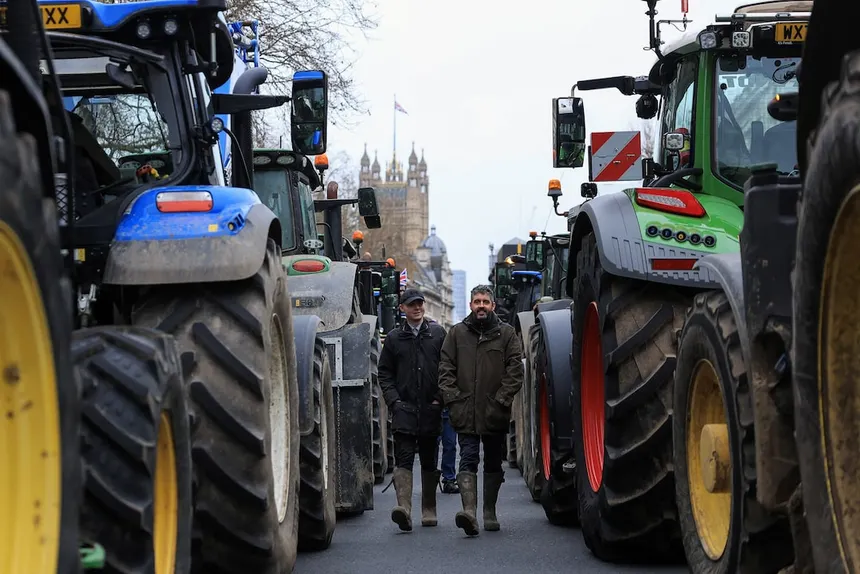
British farmers face a peculiar paradox in 2025. Whilst modern tractors deliver unprecedented precision and efficiency through sophisticated computer systems, these same digital capabilities have effectively locked farmers out of repairing their own equipment. Software restrictions, proprietary diagnostic tools, and manufacturer-controlled parts distribution have transformed straightforward mechanical repairs into costly trips to authorized dealers, with farmers watching helplessly as critical harvest windows close whilst equipment sits idle awaiting dealer service.
This isn’t merely a British problem. However, it’s increasingly a British disadvantage. Across the Atlantic and the Channel, farmers are securing legal rights to repair their own tractors through regulatory frameworks and legislation. Meanwhile, UK agriculture operates in a policy vacuum, excluded from European Union protections by Brexit and lacking domestic alternatives.
The Digital Lock-In Problem
Modern agricultural equipment bears little resemblance to the tractors farmers once maintained in their own workshops. Today’s machines contain dozens of electronic control units, millions of lines of proprietary software code, and sophisticated diagnostic systems that require manufacturer authorization to access. When equipment fails, software locks prevent independent mechanics and farmers from reading error codes, recalibrating systems, or installing replacement parts without dealer intervention.
Manufacturers defend these restrictions on intellectual property and safety grounds. Companies invest substantially in developing software systems that differentiate their products and enable precision agriculture capabilities. They argue that opening diagnostic systems to third parties risks compromising equipment safety, environmental compliance, and quality standards that authorized dealer networks maintain through manufacturer training and accountability.
Farmers counter that these justifications mask deliberate market control. When harvest cannot proceed because a sensor requires dealer activation, or when local mechanics capable of performing repairs stand idle whilst farmers await dealer appointments, the safety and quality arguments feel less compelling than the economic reality of repair monopolies.
Europe’s Regulatory Framework
EU farmers secured access rights through Regulation 167/2013 of the European Parliament and of the Council on the approval and market surveillance of agricultural and forestry vehicles. This legislation established that “manufacturers shall provide non-discriminatory access to vehicle repair and maintenance information to authorised dealers, repairers and independent operators through websites using a standardised format in a readily accessible and prompt manner.”
The regulation, enacted in 2013 with various provisions phased in subsequently, covers tractors and agricultural vehicles sold in EU member states. Enhanced requirements taking effect in 2026 strengthen these access provisions, requiring manufacturers operating in European markets to maintain standardized information portals accessible to independent repair providers.
For UK farmers, Brexit creates an awkward position. Britain is no longer covered by EU regulations, yet manufacturers selling equipment in both British and European markets must comply with EU requirements for their continental sales. This raises questions about whether equipment designed for both markets incorporates repair access capabilities that UK farmers technically possess but cannot legally utilize, or whether manufacturers maintain separate software configurations for different markets.
The practical implications remain unclear. Manufacturers have not publicly clarified whether tractors sold in the UK after 2026 will include EU-mandated repair access features. The regulatory ambiguity leaves British farmers uncertain whether they’ll benefit from European protections through market spillover or remain locked out despite purchasing equipment fundamentally capable of independent repair.
America’s State-by-State Breakthrough
Whilst Europe pursued regulatory harmonization, American farmers achieved breakthrough through state legislation. Colorado became the first US state to pass agricultural right to repair into law when Governor Jared Polis signed the Consumer Right to Repair Agricultural Equipment Act (HB 23-1011) on 25 April 2023. The legislation took effect 1 January 2024.
Colorado’s law requires manufacturers to provide owners and independent repair providers with diagnostic tools, software access, technical documentation, and parts necessary for equipment repair and maintenance. The legislation explicitly prohibits modifications that deactivate safety systems or violate emissions regulations, addressing manufacturer concerns whilst securing farmer repair rights.
The Colorado breakthrough emerged from years of farmer advocacy and bipartisan legislative support, despite vigorous manufacturer opposition. Representative Brianna Titone, who sponsored the legislation, argued that farmers deserved to control equipment they had purchased. Manufacturers countered that the law created safety risks and exposed intellectual property, but Colorado’s farming community and lawmakers concluded that repair access outweighed these concerns.
Colorado’s success has inspired similar efforts in over fifteen other US states, though most have not yet passed legislation. The American Farm Bureau Federation has negotiated voluntary memorandums of understanding with major manufacturers including John Deere, covering approximately three-quarters of agricultural machinery sold in America. However, many farmers and advocacy groups view these voluntary agreements as insufficient compared to enforceable legislation, with Colorado’s law serving as the model others seek to replicate.
UK Agriculture’s Policy Vacuum
British farmers possess neither European regulatory protection nor American legislative breakthrough. The UK has enacted no equivalent right to repair legislation for agricultural equipment. Post-Brexit, Britain sits outside the EU regulatory framework. Unlike American farmers organizing state-by-state campaigns, UK farmers have no comparable legislative pathway readily available.
The National Farmers’ Union has advocated for repair access for years, documenting cases where equipment downtime during critical periods costs farmers substantially. However, without legislative momentum or regulatory requirements, UK farmers remain dependent on manufacturer goodwill and dealer network capacity.
This creates competitive disadvantage. EU farmers gain standardized repair access by 2026. Colorado farmers secured legal repair rights in 2024, with other US states potentially following. UK farmers continue operating under manufacturer-controlled systems that prioritize dealer networks over independent repair options.
The contrast is particularly stark given Britain’s agricultural challenges. Thin margins, weather uncertainty, and increasing input costs make equipment reliability essential. When repairs require dealer appointments that take days or weeks, farmers lose productive time and potentially entire crops. Independent mechanics in rural areas often possess the mechanical skills to perform repairs but lack legal access to diagnostic systems and parts necessary to complete the work.
Three Pathways Forward
Britain faces several options for addressing agricultural equipment repair access, each with distinct implications.
Following the EU regulatory model would align British requirements with European frameworks, potentially simplifying compliance for manufacturers selling equipment in both markets. This approach offers regulatory certainty and leverages existing EU standards rather than creating entirely new frameworks. However, it raises questions about regulatory independence and whether post-Brexit Britain wishes to align closely with EU regulations.
Adopting standalone UK legislation similar to Colorado’s law would establish clear statutory requirements without reference to European frameworks. This approach asserts British regulatory sovereignty whilst securing farmer rights through domestic legislation. Parliamentary processes would be required, and manufacturers would likely mount similar opposition to that seen in Colorado, arguing safety concerns and intellectual property protection.
Industry-led voluntary solutions modeled on American Farm Bureau Federation memorandums represent a third approach. Manufacturers might negotiate agreements with NFU or other farming organizations, providing repair access through voluntary commitments rather than legislative mandates. This avoids regulatory burden but raises questions about enforcement mechanisms and whether voluntary compliance proves sufficient without legal backing.
Each pathway involves tradeoffs between regulatory alignment, legislative effort, industry cooperation, and farmer protection. The optimal approach likely depends on political appetite for agricultural regulation, manufacturer willingness to negotiate voluntarily, and urgency farmers assign to securing repair access.
The Cost of Inaction
The international right to repair movement continues gaining momentum. EU implementation in 2026 will establish standardized repair access across the European continent. American states build on Colorado’s breakthrough, with legislative campaigns advancing despite manufacturer resistance. Technology continues advancing, with increasing software complexity making repair access questions more rather than less important.
UK farmers watching these developments understand the implications. Equipment represents massive capital investments, often financed over many years. When manufacturers effectively control equipment through software restrictions long after initial purchase, farmers lose autonomy over assets they ostensibly own. Independent mechanics seeing their businesses decline understand that entire rural service sectors depend on repair access policies.
The question facing British agriculture and policymakers is straightforward: how long can the UK maintain its current approach whilst international competitors secure repair rights? EU farmers gaining access advantages by 2026 will operate with reduced downtime and lower repair costs compared to British counterparts locked into dealer networks. American farmers in Colorado and potentially other states already enjoy statutory repair rights unavailable to UK operations.
For British farming facing challenging economics and uncertain futures, equipment repair access represents more than technical policy. It’s about operational viability, rural community sustainability, and whether farmers control the tools essential to their livelihoods. As the international right to repair revolution advances, UK agriculture risks being left behind not through choice but through policy inaction.
The movement for repair rights began with farmers asserting that ownership should mean control. Europe answered with regulation. America answered with legislation. Britain has yet to answer at all.