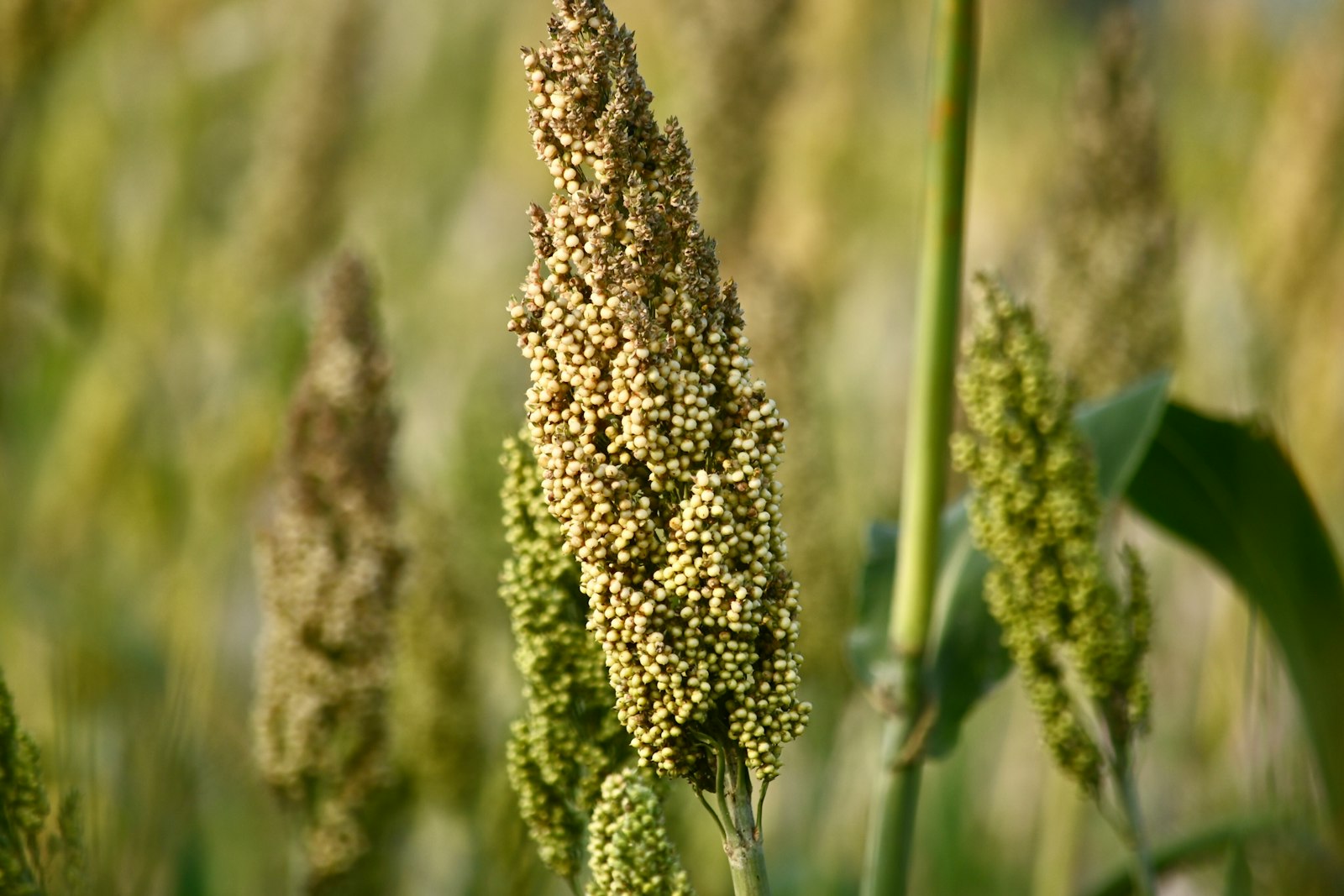
Millets are the hardy grains that India’s 2023-24 budget speech called Shree Anna, listing jowar, ragi, bajra, kuttu, ramdana, kangni, kutki, kodo, cheena and sama. The agriculture ministry’s production tables report bajra (pearl millet), jowar (sorghum), ragi (finger millet) and small millets, and add them up as Shree Anna.
For processors, exporters and traders the questions are practical: how much is grown, at what support price, how much leaves the country and what policy help exists. This explainer answers each from official data available on 1 November 2026.
What counts as millets, and why the name Shree Anna
The Shree Anna label comes from the Union Budget speech of 1 February 2023. Finance Minister Nirmala Sitharaman said: “We are the largest producer and second largest exporter of ‘Shree Anna’ in the world.” She announced that the Indian Institute of Millet Research in Hyderabad would be supported as a Centre of Excellence for sharing best practices, research and technologies internationally.
The international push came first. The UN General Assembly declared 2023 the International Year of Millets at its 75th session in March 2021, according to the Food and Agriculture Organization. The stated aims included raising awareness of the nutritional benefits of millets, their suitability for adverse and changing climatic conditions, and new market opportunities for growers and consumers.
One definition trap matters for anyone reading Indian statistics. Official tables group jowar, bajra, ragi and small millets with maize and barley as “nutri/coarse cereals”, so headline coarse cereal totals are dominated by maize. Buyers who want millets alone need the crop-by-crop lines.
Millets production in India: the latest official figures
The latest official figures are the Third Advance Estimates for 2025-26, released on 27 May 2026. The agriculture ministry put Shree Anna production at 17.584 million tonnes, within nutri/coarse cereals of 74.472 million tonnes that include a record 55.093 million tonnes of maize. The Directorate of Economics and Statistics time series gives the crop detail, in lakh tonnes, against 2024-25:
- Bajra: 108.48 (94.76 kharif, 13.72 summer), against 112.05
- Jowar: 43.56 (13.13 kharif, 30.09 rabi, 0.34 summer), against 49.55
- Ragi: 20.00, against 19.77
- Small millets: 3.80, against 4.56
The directorate’s advance estimates page listed no final estimate for 2025-26 when TAD checked on 1 November 2026. For 2024-25, the final estimates in the Economic Survey 2025-26 Statistical Appendix (Table 1.15) put bajra at 11.2 million tonnes and jowar at 5.0 million tonnes, within nutri/coarse cereals of 63.9 million tonnes.
Area, yield and where the grain comes from
The longer series shows a shift. Between 2015-16 and 2024-25, jowar area fell from 6.1 million hectares to 4.0 million hectares, while its yield rose from 697 kg to 1,240 kg a hectare. Bajra area moved from 7.1 million to 7.4 million hectares and its yield from 1,132 kg to 1,523 kg a hectare. Bajra output rose from 8.1 million to 11.2 million tonnes over the period.
For nutri/coarse cereals as a group in 2024-25, the three largest producers were Rajasthan with 9.45 million tonnes (14.78% of the national total), Karnataka with 8.59 million tonnes (13.44%) and Madhya Pradesh with 7.78 million tonnes (12.17%). Those state figures include maize.
Year-to-year swings
Output moves with the rains. The Statistical Appendix shows, in million tonnes:
- Bajra: 10.9 in 2020-21, 9.8 in 2021-22, 11.4 in 2022-23, 10.7 in 2023-24 and 11.2 in 2024-25
- Jowar: 4.8 in 2020-21, 4.2 in 2021-22, 3.8 in 2022-23, 4.7 in 2023-24 and 5.0 in 2024-25
Bajra output fell by 1.1 million tonnes between 2020-21 and 2021-22 before recovering. Jowar is mainly a rabi crop: in 2024-25 the rabi harvest of 3.2 million tonnes was almost twice the kharif crop of 1.7 million tonnes. Buyers sourcing jowar therefore watch winter conditions as much as the monsoon.
Supply depends on the weather. The Economic Survey 2025-26 says irrigation covers less than 15% of the area under millets, against about 26% for pulses and about 67% for rice. The 2026 monsoon ended at 87% of normal, as our report on the IMD season summary records, which matters for the 2026-27 kharif bajra crop.
MSP for jowar, bajra and ragi
The Cabinet approved minimum support prices for kharif 2026-27 on 13 May 2026. Per quintal, the prices are:
- Jowar (Hybrid): INR 4,023, up INR 324 from INR 3,699, a 50% margin over cost
- Jowar (Maldandi): INR 4,073, up INR 324 from INR 3,749
- Bajra: INR 2,900, up INR 125 from INR 2,775, a 56% margin over cost
- Ragi: INR 5,205, up INR 319 from INR 4,886, a 50% margin over cost
A decade of MSP increases
Table 4.5 of the Statistical Appendix tracks the rise, in INR per quintal:
- Jowar (hybrid): 1,570 in 2015-16, 2,430 in 2018-19, 2,970 in 2022-23 and 3,699 in 2025-26
- Bajra: 1,275 in 2015-16, 1,950 in 2018-19, 2,350 in 2022-23 and 2,775 in 2025-26
- Ragi: 1,650 in 2015-16, 2,897 in 2018-19, 3,578 in 2022-23 and 4,886 in 2025-26
The release said the government has been promoting nutri-cereals and Shree Anna by offering higher MSPs for them. The series in the Statistical Appendix (Table 4.5) shows the step change: between 2017-18 and 2018-19 the jowar (hybrid) MSP rose from INR 1,700 to INR 2,430, bajra from INR 1,425 to INR 1,950 and ragi from INR 1,900 to INR 2,897 a quintal.
By TAD’s calculation, the ragi MSP for 2026-27 is more than two and a half times its 2017-18 level. All kharif 2026-27 and rabi 2027-28 rates are on our support price board, and our MSP explainer covers how the Commission for Agricultural Costs and Prices recommends them.
Procurement: where MSP meets the market
An MSP only bites where the state buys. The Economic Survey says the government procures wheat, rice and coarse grains from farmers at mandis and distributes them free to weaker sections through the public distribution system. TAD did not find official procurement volumes for jowar, bajra or ragi for 2025-26 in the documents it could open, so none are given here.
In TAD’s view, the practical effect for traders is that the MSP is a firm floor only in states and seasons where procurement is active; elsewhere it serves mainly as a reference price. Our e-NAM explainer covers the online mandi channel through which some of this grain is sold.
Shree Anna policy: missions, research and incentives
Most central support runs through existing schemes. The Economic Survey says the National Food Security Mission, in place since 2007, covers nutri-cereals (Shree Anna) alongside rice, wheat, pulses and coarse cereals, and was renamed the National Food Security and Nutrition Mission in 2024-25. Its tools include demonstrations, high-yielding varieties and capacity building for farmers.
The research arm is the Indian Institute of Millet Research in Hyderabad, named in the 2023 budget speech as the Centre of Excellence.
Production-linked incentives
Food processors will ask about incentives. The Production Linked Incentive Scheme for Food Processing (PLISFPI), launched in 2021, supports branding and marketing in international markets. By 31 December 2025, 169 applications had been approved, with beneficiaries reporting investments of INR 9,207 crore and incentives disbursed of INR 2,162.55 crore, according to the Economic Survey.
The Notes on Demands for Grants 2026-27 for the food processing ministry show PLISFPI spending of INR 450.48 crore in 2024-25 and a budget estimate of INR 1,200.00 crore for 2026-27. Neither document breaks out millet products. Whether and on what terms millet-based products qualify should be checked on the ministry’s scheme pages, which TAD could not open for this explainer.
For smaller units, the Pradhan Mantri Formalisation of Micro Food Processing Enterprises (PMFME) scheme, launched in 2020, is the general route. It is not specific to millets. By 31 December 2025, 4,04,062 applications had been sent to banks, with term loans of INR 14.19 thousand crore sanctioned, and seed capital of INR 1,277.45 crore had been sanctioned for 3,65,935 women self-help group members, according to the Economic Survey.
Millets exports: what the trade data show
India’s export statistics record millets under HS subheading 1008.2, which the Department of Commerce’s export data bank reports as code 10082, split into seed (100821) and other millet (100829). The data bank, last updated on 7 August 2026, shows exports under it of USD 46.30 million (INR 407.94 crore) in 2025-26, against USD 42.22 million (INR 357.88 crore) in 2024-25. Quantity rose from 85,411,925 kg to 101,154,988 kg.
The eight-digit lines in the chapter 10 tables show which grains drive the trade in 2025-26:
- Bajra (grain): 55,105,372 kg worth USD 19.70 million (INR 174.02 crore)
- Ragi (grain): 15,053,701 kg worth USD 5.92 million (INR 52.17 crore)
- Bajra seed: 12,332,216 kg worth USD 6.11 million (INR 53.63 crore)
- Amaranth (grain), which India’s eight-digit tariff lines place under millet (10082991): 4,228,837 kg worth USD 5.03 million
- Jawar (grain) under the millet subheading: 2,728,185 kg worth USD 1.49 million
Volumes grew faster than values. Bajra grain exports rose from 49,533,986 kg in 2024-25 to 55,105,372 kg in 2025-26, an increase of 11.25%, but their dollar value rose only 1.35%, from USD 19.44 million to USD 19.70 million. By TAD’s calculation, the average export value per kg of bajra grain fell by roughly 9%. Ragi grain fell 4.01% in quantity and 2.68% in dollar value.
Sorghum is mostly recorded separately as grain sorghum (HS 1007): USD 14.93 million in 2025-26, down 10.13% from USD 16.61 million. That includes seed worth USD 5.68 million. Amaranth, by contrast, sits inside the millet subheading: its seed and grain lines came to USD 6.71 million in 2025-26, by TAD’s calculation. Millet flours, flakes and snacks fall under other headings and are not captured above; APEDA’s product-level data could not be retrieved for this explainer.
Where the grain goes
The country tables in the same data bank show a trade centred on the Gulf, North Africa and India’s neighbours. For the millet subheading as a whole in 2025-26, the largest markets were the United Arab Emirates (USD 9.00 million), Saudi Arabia (USD 5.20 million), Nepal (USD 4.63 million), the United States (USD 3.82 million) and Morocco (USD 2.30 million).
- Bajra grain went mainly to the UAE (USD 5.07 million), Saudi Arabia (USD 4.07 million), Libya (USD 1.65 million), Morocco (USD 1.53 million) and Algeria (USD 1.46 million).
- Ragi grain went overwhelmingly to Nepal: 12,958,087 kg worth USD 4.47 million, out of USD 5.92 million in total.
The small millets are minor in trade terms. Foxtail millet grain exports were 2,186,568 kg worth USD 1.08 million in 2025-26, and the barnyard, proso, kodo and little millet grain lines were each below 600,000 kg. Proso and foxtail seed lines grew several-fold, but from very small 2024-25 bases.
Set against India’s total exports of USD 441,452.14 million in 2025-26, the millet subheading is a very small line. For scale, the Economic Survey puts India’s agri-food exports, including processed foods, at USD 49.43 billion in 2024-25. The 2023 claim that India is the second largest exporter of Shree Anna is the government’s own; TAD has not verified a current global ranking.
What millets mean for food processors, brands and exporters
For businesses buying or selling millets, the official numbers point to a large domestic crop, a small export trade and rising support prices. The implications differ by business type.
Food processors and brands
Raw material is plentiful in volume terms, with 108.48 lakh tonnes of bajra and 43.56 lakh tonnes of jowar estimated for 2025-26, but heavily rain-fed and concentrated in a few states. In TAD’s view, processors who need consistent quality will contract with farmer producer organisations or aggregators in Rajasthan, Karnataka and Madhya Pradesh rather than rely on spot mandi supply, and will price against an MSP floor that has risen every year since 2015-16. Ragi, at INR 5,205 a quintal, is the most expensive of the three.
Exporters
Export volumes are small and led by bajra grain, which made up about 43% of the subheading’s value in 2025-26 by TAD’s calculation. Several small millet lines grew fast from tiny bases. The buyer base is concentrated: the UAE and Saudi Arabia together took USD 14.20 million of the subheading’s USD 46.30 million in 2025-26, so conditions in two Gulf markets shape almost a third of the trade by value. For context on how sudden policy shifts have hit India’s larger grain trade, our rice export explainer sets out the restrictions imposed and lifted since 2022.
Seed companies
Seed is a meaningful slice of the trade: bajra seed exports were worth USD 6.11 million and sorghum seed USD 5.68 million in 2025-26. Seed suppliers listed in our seeds and planting material category are the businesses most exposed to this part of the trade.
Traders, FPOs and storage operators
In TAD’s view, where procurement is thin, private trade carries most of the crop from field to processor. That puts a premium on cleaning, grading and storage close to growing areas, the services listed in our post-harvest and storage category. Our Markets desk reports MSP, procurement and trade data as they are released.
Millets: what is still unsettled
Several things a buyer would want to know were not settled, or not published in a form TAD could open, as of 1 November 2026:
- 2025-26 output. The figures above are third advance estimates; final estimates for 2025-26 will replace them.
- The 2026 kharif crop. With the monsoon ending at 87% of normal, the size of the 2026-27 kharif bajra harvest is not yet reflected in official estimates TAD has seen.
- The rabi outlook. WMO and NOAA expect El Niño to reach record strength into early 2027, as our climate report sets out; the effect on the rabi jowar crop is not yet known.
- Procurement. TAD found no official 2025-26 procurement volumes for jowar, bajra or ragi.
- Incentive terms. The PLISFPI terms for millet-based products could not be verified from the ministry’s own pages.
- Trade classification. India’s millet subheading includes amaranth, and processed millet products sit elsewhere, so published totals need care.
Millets: frequently asked questions
What does Shree Anna mean?
Shree Anna is the name the Union Budget speech of 1 February 2023 gave to millets. The speech listed jowar, ragi, bajra, kuttu, ramdana, kangni, kutki, kodo, cheena and sama, said India was the largest producer and second largest exporter, and named the Indian Institute of Millet Research in Hyderabad as a Centre of Excellence.
What is India’s millets production?
The Third Advance Estimates for 2025-26, released on 27 May 2026, put Shree Anna production at 17.584 million tonnes: bajra 108.48 lakh tonnes, jowar 43.56 lakh tonnes, ragi 20.00 lakh tonnes and small millets 3.80 lakh tonnes. The final estimates for 2024-25 put bajra at 11.2 million tonnes and jowar at 5.0 million tonnes. Nutri/coarse cereals totals are much larger because they include maize.
What are the MSPs for jowar, bajra and ragi in 2026-27?
For kharif 2026-27, approved on 13 May 2026, the MSP is INR 4,023 a quintal for jowar (hybrid), INR 4,073 for jowar (maldandi), INR 2,900 for bajra and INR 5,205 for ragi. The increases over 2025-26 are INR 324, INR 324, INR 125 and INR 319 respectively.
What are India’s millets exports worth?
Department of Commerce data show exports under HS subheading 1008.2 (millet, including seed and amaranth) of USD 46.30 million (INR 407.94 crore) in 2025-26, up from USD 42.22 million in 2024-25. Bajra grain was the largest line at USD 19.70 million. Grain sorghum, recorded separately under HS 1007, added USD 14.93 million.
Which countries buy India’s millets?
Department of Commerce data for 2025-26 show the United Arab Emirates as the largest market for the millet subheading, at USD 9.00 million, followed by Saudi Arabia, Nepal, the United States and Morocco. Bajra grain went mainly to the Gulf and North Africa, while almost all ragi grain exports, worth USD 4.47 million of USD 5.92 million, went to Nepal.
Was 2023 the International Year of Millets?
Yes. The UN General Assembly declared 2023 the International Year of Millets at its 75th session in March 2021, according to the Food and Agriculture Organization. The aims included awareness of nutritional benefits, the crops’ suitability for changing climatic conditions and new market opportunities for growers and consumers.
Is there a PLI scheme for millet products?
The Production Linked Incentive Scheme for Food Processing, launched in 2021, had 169 approved applications and INR 2,162.55 crore of incentives disbursed by 31 December 2025, and has a budget estimate of INR 1,200.00 crore for 2026-27. TAD could not verify the terms for millet-based products from the ministry’s own pages.