Natural farming is India’s name for chemical-free cultivation that relies on livestock-based preparations made on or near the farm instead of bought fertilisers and pesticides. The Union Cabinet turned it into a national programme on 25 November 2024 when it approved the National Mission on Natural Farming (NMNF) with an outlay of INR 2,481 crore.
By 11 August 2026 the mission reported 26.76 lakh farmers on 12.60 lakh hectares. This explainer sets out the rules, the money, the evidence and what the shift means for companies that sell to, buy from or finance these farms.
What natural farming is, and how it differs from organic farming
The agriculture ministry describes natural farming as chemical-free farming built around livestock, preferably a local cow breed, and diversified crops rooted in Indian traditional knowledge, according to a Press Information Bureau note of 13 August 2025. Farmers prepare inputs such as Jeevamrit and Beejamrit themselves or buy them from local Bio-input Resource Centres. Beejamrut, a seed treatment, is made mainly from cow dung, cow urine and forest soil, the note says.
The approach grew out of zero budget natural farming, a method developed by Subhash Palekar. A 2025 paper in Nature Ecology & Evolution describes its four practices: a microbial inoculum (jiwamrita), a second microbial culture to protect young roots (beejamrita), mulching (acchadana) and better soil aeration with less tillage and irrigation (whapahasa). Farmers are also encouraged to keep cover crops, intercrop and plant hedgerows.
Organic farming runs on a separate track. The Paramparagat Krishi Vikas Yojana (PKVY) pays INR 31,500 per hectare over three years and had covered 16.90 lakh hectares as of 31 October 2025, according to a PIB note of 23 August 2026. Organic produce is certified either by third-party bodies under the NPOP, which APEDA manages for the commerce ministry, or through farmer groups under the Participatory Guarantee System, PGS-India Organic.
Natural farming now has its own scheme and its own certificate, PGS-India Natural. The NMNF is a restructured form of Bharatiya Prakritik Krishi Paddhati, which ran under PKVY from 2020-21 to 2022-23, the August 2025 note says. The PGS labels for organic and natural produce are run by one body, the National Centre for Organic and Natural Farming (NCONF) in Ghaziabad, which matters for any business that has to deal with both.
The NMNF: approval, outlay and targets
The Cabinet approved the NMNF as a standalone centrally sponsored scheme under the Ministry of Agriculture and Farmers Welfare. The outlay of INR 2,481 crore ran until the end of the 15th Finance Commission period in 2025-26, with INR 1,584 crore from the Centre and INR 897 crore from the states, according to the government’s announcement of 25 November 2024. The targets set at approval were:
- 15,000 clusters in willing gram panchayats, covering 7.5 lakh hectares
- 1 crore farmers reached, with 18.75 lakh trained farmers preparing their own inputs
- 10,000 Bio-input Resource Centres (BRCs), set up where needed
- around 2,000 model demonstration farms at Krishi Vigyan Kendras, agricultural universities and farmers’ fields
- 30,000 Krishi Sakhis or community resource persons (CRPs) for awareness and handholding
A cluster is about 50 hectares of contiguous land with about 125 farmers, the ministry told the Lok Sabha on 22 July 2025, as recorded by PIB. Each enrolled farmer can receive an output-based incentive of INR 4,000 per acre per year for two years, for up to one acre. A Lok Sabha answer of 28 July 2026 (Starred Question 127) lists the other rates: INR 2,100 per hectare for certification for two years, INR 50,000 per model demonstration farm and INR 1,00,000 per BRC.
What has been spent
Spending started slowly. The Notes on Demands for Grants 2026-27 show actual NMNF expenditure of INR 10.35 crore in 2024-25, a revised estimate of INR 725.00 crore for 2025-26 against a budget estimate of INR 616.01 crore, and a budget estimate of INR 750.00 crore for 2026-27. Starred Question 127 put cumulative expenditure at INR 65,924.34 lakh by 28 July 2026.
The 2026-27 allocation shows the NMNF continuing past its original 2025-26 horizon, and the ministry’s July 2026 answer reports cluster data for FY 2024-25 to 2026-27. TAD did not find a separate Cabinet decision setting the mission’s terms beyond 2025-26.
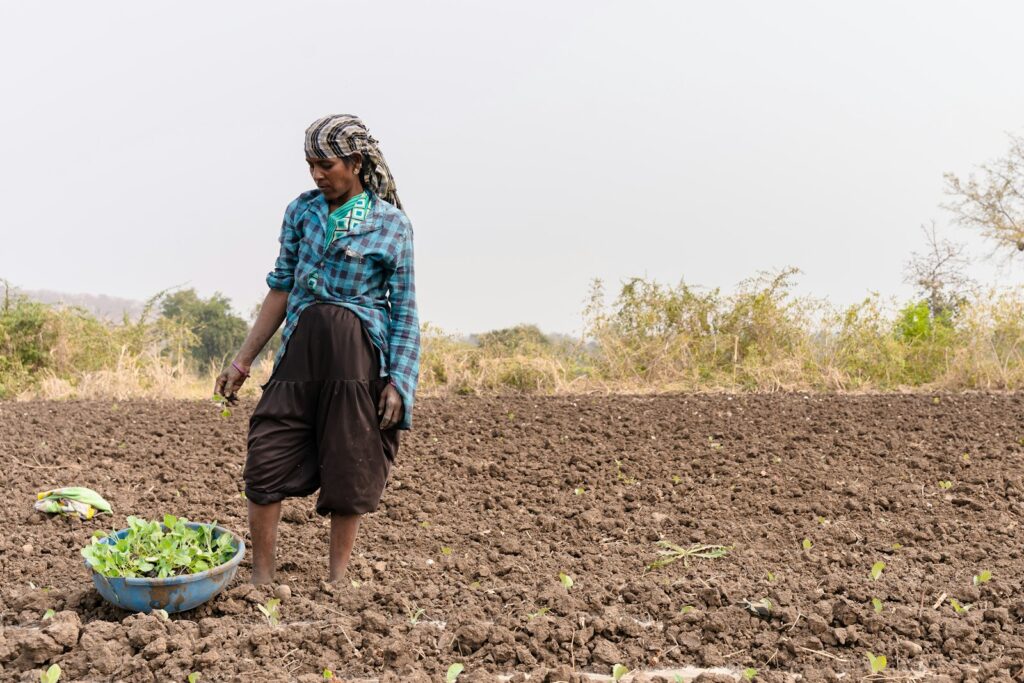
Natural farming in numbers: NMNF progress to August 2026
Official progress figures have reached Parliament in stages, and the totals move quickly, so each set below carries its date.
- 22 July 2025: more than 10 lakh farmers enrolled, 7,934 BRCs identified and 2,045 set up, 1,100 model farms developed and about 28,000 CRPs identified (PIB, Lok Sabha reply).
- 5 December 2025: 17,639 clusters in 623 districts and 8.79 lakh farmers trained (PIB, Rajya Sabha reply).
- 5 March 2026: 18,786 clusters on 8.80 lakh hectares, 18.19 lakh farmers enrolled and 33,676 CRPs trained (PIB note of 23 August 2026).
- 28 July 2026: 23,331 clusters on 11,44,259.302 hectares and 23,13,238 farmers supported (Starred Question 127).
- 11 August 2026: 24,102 clusters on 12.60 lakh hectares, 26.76 lakh farmers, 8,100 BRCs and 40,182 Krishi Sakhis or CRPs deployed (Lok Sabha Starred Question 331).
On those figures, the NMNF passed its area and cluster targets within two years of approval. Enrolment of 26.76 lakh farmers is just over a quarter of the 1 crore farmers the mission set out to reach, and BRCs stood at 8,100 against 10,000. The ministry said in its August 2026 answer that district-wise and gender data are not maintained centrally.
Where the farmers are
The state-wise annexure to the 11 August 2026 answer shows a concentrated map. The five largest states by enrolment were:
- Andhra Pradesh: 6,55,659 farmers on 4,34,156.56 hectares
- Uttar Pradesh: 2,90,500 farmers on 1,16,200 hectares
- Maharashtra: 2,74,875 farmers on 1,09,950 hectares
- Rajasthan: 2,66,596 farmers on 1,12,865.58 hectares
- Madhya Pradesh: 1,97,661 farmers on 91,199.66 hectares
Together these five states hold about 63% of enrolled farmers, by TAD’s calculation from the annexure. At the other end, Punjab had 6,418 farmers on 2,122.48 hectares and Haryana 13,600 farmers on 10,703.21 hectares.
Andhra Pradesh: the state programme that came first
Andhra Pradesh ran natural farming at scale long before the national mission. Andhra Pradesh Community Managed Natural Farming (APCNF) is led by the state government through Rythu Sadhikara Samstha (RySS). The APCNF website lists 1,773,432 farmers on 926,387 hectares across 8,168 gram panchayats, 662 mandals and 28 districts. The page does not say what date those figures refer to.
The state has incentivised conversion since 2016, mainly through training, according to the Nature Ecology & Evolution paper. On 2 June 2026 APCNF won the Food Planet Prize 2026, worth $1.5 million, the prize’s organisers announced. Down To Earth reported that Chief Minister N. Chandrababu Naidu said the state aimed to be 100% natural by 2047, and that the state agriculture minister, Kinjarapu Atchannaidu, said more than 60% of community resource persons training farmers were women.
The programme matters beyond the state for two reasons. The Nature Ecology & Evolution paper calls it the largest agroecological transition in the world, and much of the peer-reviewed evidence on yields and profits was gathered on its farms, with RySS funding one study and supporting fieldwork on another.
Natural farming yields: what the research shows
The evidence is mixed and depends heavily on where and how the comparison is made. Four bodies of work stand out, and the sceptics have a case too.
The nitrogen warning, 2020
A modelling study by Jo Smith, Jagadeesh Yeluripati, Pete Smith and Dali Rani Nayak, published in Nature Sustainability in March 2020, estimated that even with optimistic assumptions about biological nitrogen fixation, zero budget natural farming would replace only about 52 to 80% of the nitrogen supplied by national-average fertiliser use. The authors warned of yield losses on higher-input farms, saw possible gains for low-input farmers and called for more research before mass conversion.
Field trials in Andhra Pradesh, 2023
A field study led by Sarah Duddigan, published in Agronomy for Sustainable Development (volume 43, article 31, 2023), compared natural, organic and conventional plots on 28 farms in six Andhra Pradesh districts over three seasons from kharif 2019 to kharif 2020. With all farm experiments analysed together, yields were significantly higher under natural farming than under either alternative, with groundnut kernel yield and tomato fruit mass per plant about 30 to 40% higher, though results varied by district and crop.
The authors linked the gain mainly to mulching, which kept soil cooler and moister and raised earthworm numbers, and found no significant difference from conventional plots in most nutrient measures. They called for long-term trials at larger scale. Funding came from the University of Reading’s Research England Global Challenges Research Fund, RySS and KfW Development Bank.
Profits and birds, 2025
A team led by Iris Berger published its results in Nature Ecology & Evolution on 19 September 2025 (volume 9, pages 2057 to 2068). It matched natural farming and agrichemical farm areas in northern Andhra Pradesh, surveyed between 2021 and 2023, and conducted 128 farmer interviews covering 66 natural farming and 62 agrichemical fields. It found natural farming more than doubled farmers’ economic profits while keeping crop yields comparable, and bird numbers improved. University of Cambridge funds supported the lead author.
ICAR and NITI Aayog
The government’s own trial network is the ICAR All India Network Programme on Natural Farming, started in 2020-21 with 20 centres in 16 states testing eight cropping systems. In its August 2026 answer, the ministry said five-year average system productivity under complete natural farming was about 5% higher than organic farming or integrated crop management in Himachal Pradesh, Uttarakhand and Sikkim, equivalent in Madhya Pradesh and Chhattisgarh, and comparable to integrated crop management in Gujarat and Rajasthan.
Soil organic carbon in the Himalayan trials rose from about 0.90% to 1.15%, the answer said. Two caveats apply: these results were reported in a parliamentary answer, not a peer-reviewed paper, and the comparison is with organic and integrated management. The answer also cited a NITI Aayog assessment in which 91.2% of adopters reported higher productivity and better soil health and 90.1% reported lower costs. Those are farmers’ own reports.
The sceptics
In September 2019 the National Academy of Agricultural Sciences called zero budget natural farming an unproven technology and advised the government not to invest money and staff in promoting it, Scroll reported, citing The Indian Express. The academy said a session with about 75 experts found no verifiable data supporting it. Subhash Palekar said the academy lacked the expertise to validate his method.
Certification, branding and market linkage
At approval, the government promised farmers a simple certification system and common branding. NCONF built the online Natural Farming Certification System (NFCS) under the Participatory Guarantee System, branded PGS-India Natural, and online registration and certification were live by 5 December 2025, according to PIB. The August 2025 note also refers to a common national brand for naturally grown, chemical-free produce.
By 28 July 2026, more than 22.47 lakh farmers had registered under the NFCS and more than 14.43 lakh had received natural farming certificates, according to Starred Question 127. The ministry said certified products are sold in markets and on the Open Network for Digital Commerce (ONDC) for business-to-consumer sales.
PGS relies on peer review within farmer groups, which keeps costs below those of third-party inspection. The PGS-India FAQ says PGS certification applies to local and domestic markets and that PGS-certified products cannot be exported as organic. TAD found no official statement on whether PGS-India Natural certificates carry any standing in export markets.
Questions over the pace
The speed of certification has drawn criticism. Down To Earth reported on 22 December 2025 that regional councils handling PGS certification were told in a 2 December circular to register 5,000 to 10,000 non-scheme farmers each under organic or natural farming within six months. Councils said their costs were not funded, estimating INR 500 to INR 700 per farmer, and an open letter from 16 people warned that certificates might be issued without adequate field verification.
What natural farming means for input makers, buyers and FPOs
The NMNF covered 12.60 lakh hectares in August 2026, concentrated in a handful of states and paid for largely by the Centre. Its effects on business fall unevenly, and some of them are still speculative.
Fertiliser and crop protection companies
For fertiliser and crop protection companies, the practical effect is local rather than national. Demand falls on certified plots, but the farmer incentive is capped at one acre and five states hold about 63% of enrolled farmers. In TAD’s view, sales teams in Andhra Pradesh, Uttar Pradesh, Maharashtra, Rajasthan and Madhya Pradesh are the most exposed. Our explainer on nano DAP and nano urea covers the other big policy push on fertiliser use.
Biologicals and bio-input suppliers
The BRC network is the clearest new channel. Each centre can receive INR 1,00,000 and may be run by practising farmers, PACS, FPOs, self-help groups or rural entrepreneurs. Most NMNF inputs are farm-made preparations, not branded products, so in TAD’s assessment the opening for manufacturers lies more in supplying and training BRC operators than in selling packaged inputs to farmers.
Whether a commercial product may be used on a certified natural farming plot depends on the NFCS standards, which suppliers should read before marketing to these farmers. Companies listed in our biologicals supplier category and readers of our biostimulants regulation guide will find the overlap between the two regimes worth tracking.
Food buyers, processors and retailers
The certified pool is large on paper, with more than 14.43 lakh certificate holders by July 2026. Buyers should weigh two limits: PGS certificates are a domestic-market instrument, and the verification behind them has been questioned. Overseas policy still centres on organic standards: in England, for example, Defra has set an ambition for 10% of farmland to be organic by 2036.
FPOs, cooperatives and certifiers
The mission gives preference to areas with existing natural farmers and institutions such as state rural livelihood missions, PACS and FPOs. For FPOs, the openings are running BRCs, aggregating certified produce and handling group certification paperwork. The risk is investing in certification that buyers do not yet reward: TAD has not found official data on price premiums for natural farming produce. Firms in our testing and certification category may find work in verification.

Natural farming policy: what is still unsettled
Several questions remain open as of 1 November 2026, and each could change the business case.
- The funding horizon. The approved outlay ran to 2025-26. INR 750.00 crore is budgeted for 2026-27, but TAD found no published decision setting the NMNF’s terms for the 16th Finance Commission period.
- The farmer target. Enrolment stood at 26.76 lakh in August 2026 against a goal of 1 crore.
- State funding. G V Ramanjaneyulu, executive director of the Centre for Sustainable Agriculture, a PGS regional council, told Down To Earth in December 2025 that the state share had not been released in several states.
- Certification credibility. Councils and campaigners have questioned how fast certificates are being issued.
- The evidence base. The peer-reviewed results come largely from Andhra Pradesh. Long-term trials and studies of irrigated, higher-input systems are still thin.
For readers following soil and climate policy, our Soil, water & climate desk will report new parliamentary figures, budget lines and any revised NMNF guidelines as they are published.
Natural farming: frequently asked questions
What is natural farming in India?
Natural farming is chemical-free cultivation built around livestock, preferably a local cow breed, and diversified crops, according to the agriculture ministry. Farmers use preparations such as Jeevamrit and Beejamrit made on the farm or bought from local Bio-input Resource Centres instead of synthetic fertilisers and pesticides. It grew out of zero budget natural farming and is promoted nationally through the NMNF, approved on 25 November 2024.
What is the NMNF and how much money does it have?
The NMNF is a centrally sponsored scheme approved by the Union Cabinet on 25 November 2024 with an outlay of INR 2,481 crore to 2025-26: INR 1,584 crore from the Centre and INR 897 crore from the states. Budget documents show actual spending of INR 10.35 crore in 2024-25, a revised INR 725.00 crore for 2025-26 and INR 750.00 crore budgeted for 2026-27.
How many farmers are covered?
The agriculture ministry told the Lok Sabha on 11 August 2026 that the mission had formed 24,102 clusters covering 12.60 lakh hectares, with 26.76 lakh farmers enrolled, 8,100 Bio-input Resource Centres and 40,182 Krishi Sakhis or community resource persons. The original targets were 7.5 lakh hectares, 15,000 clusters and 1 crore farmers. Andhra Pradesh had the most farmers enrolled.
How is natural farming different from organic farming?
The two run under separate schemes and carry separate certificates. Organic farming is supported through PKVY, at INR 31,500 per hectare over three years, and certified under NPOP or PGS-India Organic. Natural farming is supported through the NMNF and certified under PGS-India Natural. The ministry defines natural farming as chemical-free and livestock-based, with inputs prepared on the farm or at local resource centres.
Does natural farming reduce crop yields?
The evidence is mixed. A 2023 field study on 28 Andhra Pradesh farms found significantly higher yields than organic or conventional plots, and a 2025 Nature Ecology & Evolution study found comparable yields with profits more than doubled. A 2020 Nature Sustainability modelling study warned that nitrogen limits could cut yields on higher-input farms. ICAR trials reported results comparable to, or slightly above, organic and integrated management.
How is natural farming produce certified, and can it be exported?
Produce is certified through the Natural Farming Certification System run by NCONF under PGS-India, branded PGS-India Natural. More than 14.43 lakh farmers had certificates by 28 July 2026. The PGS-India FAQ says PGS certification applies to local and domestic markets and PGS-certified products cannot be exported as organic. TAD found no official statement on export standing for natural farming certificates.